You do not need to become a content creator to generate leads
If the phrase “social media lead generation” makes you think of daily hot takes, polished carousels, and begging the algorithm for reach, it is no wonder you hate it.
A lot of founders, consultants, agencies, and lean teams do not want to post every day. They do not want to build a personal brand from scratch. They do not want to perform in public just to get pipeline.
The good news is that posting is only one way to use social platforms for leads. It is not the only way, and for many teams it is not the fastest way.
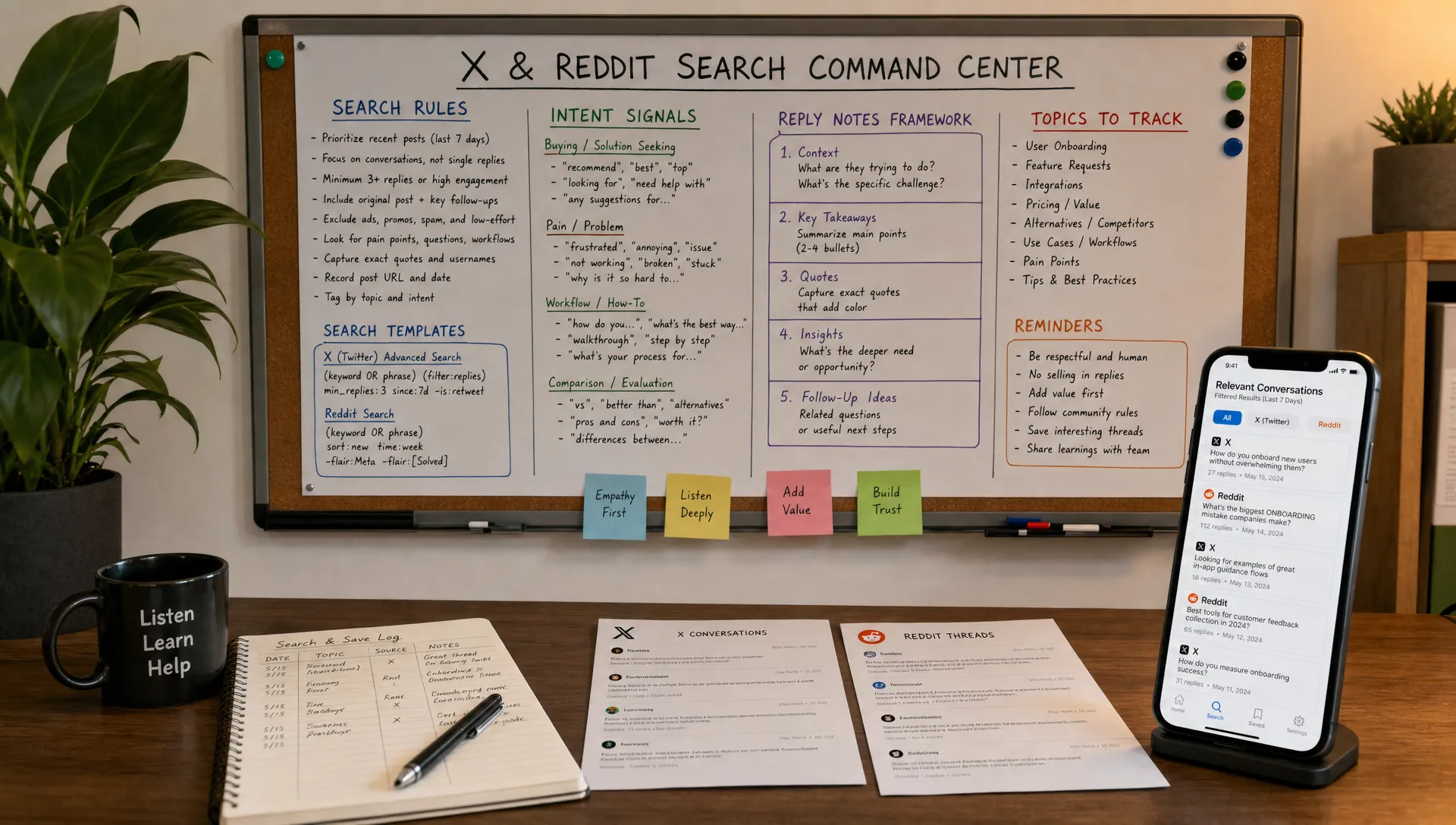
There is a quieter, more direct approach: monitor public conversations where people are already asking questions, comparing tools, complaining about problems, or looking for recommendations. Then show up with a useful reply.
That is social media lead generation for people who hate posting. It is less about broadcasting and more about listening well, responding quickly, and building trust one relevant conversation at a time.
The quiet version of social media lead generation
Most social advice assumes you need an audience before you can generate leads. That is true if your strategy depends on reach. But it is not true if your strategy depends on intent.
On X and Reddit, people publicly reveal what they are trying to solve every day. They ask for tool recommendations. They share frustration with a current workflow. They compare vendors. They describe a project they are about to start. They ask communities what to buy, who to hire, or how to fix something.
Those moments matter because the person is not passively scrolling. They are actively looking for input.
This is the core shift. Instead of asking, “What should I publish today?” you ask, “Who is already talking about a problem we can help with?”
That is why public conversations can be such a strong source of pipeline. If you want the broader strategic view, Pounce has a deeper breakdown of why inbound lead generation starts in public conversations, but the practical takeaway is simple: buyer intent is often visible before someone fills out a form.
Why replies can beat posts when you hate posting
Posting asks you to predict what people will care about. Replying lets you respond to what someone has already said.
That difference changes everything.
When you publish a post, you are usually playing a volume game. You write, publish, wait, and hope the right people see it. Maybe the algorithm helps. Maybe it does not. Maybe the post reaches buyers. Maybe it mostly reaches peers.
When you reply to a high-intent conversation, the context is already there. You know the topic. You know the pain. You know the language the buyer uses. You can make your answer specific, which is exactly what most cold outreach lacks.
For people who dislike posting, replies also reduce the emotional friction. You do not need to invent a thought leadership angle. You do not need to announce yourself. You are simply being helpful in a conversation that already exists.
Here is the practical difference:
| Approach | What you depend on | Best for | Main risk |
|---|---|---|---|
| Posting | Reach, consistency, audience fit | Building long-term authority | Slow feedback and uncertain visibility |
| Cold DMs | Targeting, volume, message quality | Direct outbound campaigns | Feels intrusive if timing is wrong |
| Intent-based replies | Relevance, timing, usefulness | Finding active buyers in public | Requires good filtering and fast responses |
This does not mean posting is bad. Posting can compound over time. But if you hate it, forcing yourself into a creator workflow may not be the best first move. Replies can create conversations without requiring an audience first.
What high-intent social conversations look like
The hardest part is not replying. It is knowing which conversations are worth your time.
A post is not a lead just because it mentions your category. Someone saying “CRM” or “email marketing” or “analytics” is not automatically in-market. You are looking for signals that suggest pain, urgency, evaluation, or action.
Use this table as a simple intent map:
| Signal | Example wording | What it usually means | Best response angle |
|---|---|---|---|
| Recommendation request | “What tool do you use for...” | They are open to options | Share a short decision framework |
| Pain or frustration | “I am tired of manually doing...” | The current workflow is costly | Explain the tradeoff and offer a fix |
| Comparison | “Anyone tried X vs Y?” | They are evaluating vendors | Give an honest comparison, including fit |
| Implementation blocker | “How do I set up...” | They may need guidance or service help | Answer the specific step they are stuck on |
| Budget or buying question | “Is there a cheaper way to...” | They care about ROI or cost | Clarify when paying is worth it |
| Urgency | “Need this by next week” | They have a near-term trigger | Offer a direct path and next step |
Low-intent conversations are different. They are often broad opinions, memes, debates, or vague mentions with no problem attached. Those can be useful for learning, but they are rarely the best use of a 15-minute lead generation session.
Build a no-posting lead generation system
You do not need a complicated funnel to start. You need a repeatable loop that helps you find relevant conversations, qualify them, reply with substance, and learn from the results.
Define buying situations, not just personas
Most lead generation starts with an ideal customer profile. That is useful, but for social media lead generation, you also need to define the situations that make someone worth engaging.
A persona might be “solo SaaS founder.” A buying situation is more specific: “solo SaaS founder looking for ways to find users without running ads.”
That second version is much easier to detect in public conversations.
Write down the moments that usually happen before someone needs you. For Pounce, examples might include people asking how to find leads on Reddit, complaining that cold DMs are not working, or looking for ways to monitor X for prospects. For your business, the triggers will be different, but the principle is the same.
Monitor X and Reddit with focused rules
Manual searching works for a short experiment, but it gets tiring fast. You need search rules that reflect real intent, not just category keywords.
Good search rules often combine a problem, an action, and a context. For example:
- “looking for” plus your category
- “anyone recommend” plus the problem you solve
- “alternative to” plus a competitor
- “how do I” plus a painful workflow
- “tired of” plus a manual process
- “best way to” plus the outcome your buyer wants
Pounce is built around this kind of workflow: real-time X and Reddit monitoring, AI-powered filtering, customizable search rules, and an inbox for relevant posts. The point is not to watch everything. It is to surface the conversations that are actually worth a reply.
For a broader platform-specific approach, see this guide to lead generation strategy for X and Reddit.
Qualify before you reply
Not every relevant post deserves your time. Before replying, ask whether the person appears to have a real problem, whether your experience can add useful context, and whether the thread is still fresh enough for your response to matter.
A good reply usually fits into one of three categories: it teaches something, clarifies a decision, or offers a concrete next step. A weak reply simply says, “We can help.”
The difference is huge. People can feel when you are using their post as an excuse to pitch. They can also feel when you actually understood the problem.
Let the system improve over time
The first version of your monitoring rules will be imperfect. That is normal. You will see false positives, irrelevant mentions, and conversations that look promising but go nowhere.
Treat that as training data. Keep the phrases that lead to good conversations. Remove terms that create noise. Notice which subreddits or X communities produce thoughtful replies. Track which reply angles get responses.
Pounce includes automatic filter improvement and session stats tracking, which matters because this channel works best when you learn from repeated short sessions, not one-off bursts.

The reply formula for people who do not want to sound salesy
If you hate posting, you may also hate sounding promotional. That is a good instinct. Public replies work best when they feel like a useful contribution first.
Use this simple structure:
| Reply part | Purpose | Example |
|---|---|---|
| Acknowledge the context | Show you read the post | “If your main issue is finding people already asking for solutions, that is a different problem than growing followers.” |
| Add a useful distinction | Teach something small | “I would separate broad keyword mentions from buying-intent phrases like ‘looking for,’ ‘alternative to,’ or ‘anyone recommend.’” |
| Share a practical next step | Make the advice usable | “Start with 5 to 10 phrases, review results daily, and remove anything that brings vague discussion instead of active requests.” |
| Offer help lightly | Create a path without pressure | “Happy to share a few example searches if useful.” |
Notice what is missing: no hard pitch, no generic compliment, no wall of text, and no fake urgency.
The best replies feel like they could stand alone even if the person never becomes a customer. That is exactly why they build trust.
What to send when someone responds
Once someone replies positively, the next step should match the conversation. Sometimes that means answering one more question in public. Sometimes it means moving to DM. Sometimes it means sending a resource.
The key is to avoid a sudden context switch. If your public reply was helpful and your DM immediately becomes a sales script, trust drops.
A better follow-up sounds like this:
“Glad that helped. Based on what you described, I would start with these three search patterns. If you want, I can also take a quick look at your current approach and point out where the noise is coming from.”
That is specific, relevant, and easy to say yes to.
Resources can also help when they are directly tied to the problem. A checklist, template, teardown, short guide, or example search map can make the conversation more concrete. If you sell digital resources, templates, reports, or private files, a tool like Cloudon’s Telegram-first file sharing and pay-to-unlock workflow can help you package and share those assets cleanly across chats and social channels.
The important part is that the asset should support the conversation. Do not send a generic brochure when someone asked a specific question.
A 15-minute daily workflow for people who hate posting
You do not need to live on social media to make this work. In fact, it is better if you do not. A short, focused routine prevents the channel from turning into another endless feed.
Here is a simple 15-minute workflow:
| Time | Action | Goal |
|---|---|---|
| 3 minutes | Review your filtered inbox | Find the few conversations that match real intent |
| 5 minutes | Qualify the best posts | Skip vague, old, or low-fit threads |
| 5 minutes | Draft and send replies | Add useful context while the conversation is fresh |
| 2 minutes | Log outcomes | Note which topics, phrases, and replies performed |
This is where daily reply goals can be useful. The goal is not to spray replies everywhere. It is to build the habit of showing up consistently in the right places.
With Pounce, the workflow is designed around quick sessions: monitor X and Reddit, review surfaced posts, use AI-assisted reply drafting when helpful, and track your session stats. You still bring the judgment. The tool reduces the time spent searching, filtering, and staring at a blank reply box.
Common mistakes that make reply-based lead generation fail
The first mistake is replying too late. Social conversations decay quickly, especially on X. If someone asked for recommendations yesterday and already received 40 answers, your reply has to be unusually good to stand out.
The second mistake is treating every mention like a lead. Keyword matching alone creates noise. You want intent, not just relevance.
The third mistake is over-automating the human part. AI can help you monitor, filter, and draft, but fully automated replies are risky. They often miss nuance, community norms, and the emotional tone of the post.
The fourth mistake is pitching before helping. If your first sentence is about your product, you are probably moving too fast. Lead with the buyer’s problem. Mention your offer only when it naturally fits.
The fifth mistake is quitting before the feedback loop gets useful. Your first week will teach you which queries are noisy, which communities dislike vendors, which topics produce buyers, and which reply angles earn responses. That learning is part of the system.
How to measure whether it is working
Social media lead generation can feel fuzzy if you only measure likes. Likes are not the point. Replies, DMs, calls, trials, and qualified conversations matter more.
Track a small set of metrics that connect to pipeline:
| Metric | Why it matters | What to improve if it is weak |
|---|---|---|
| Relevant posts found | Shows whether your monitoring rules work | Tighten or expand search phrases |
| Replies sent | Shows whether you are taking enough shots | Set a realistic daily reply goal |
| Response rate | Shows whether your replies are resonating | Make replies more specific and less pitchy |
| Qualified conversations | Shows whether you are reaching the right people | Improve intent filters and community selection |
| Next steps booked | Shows commercial impact | Improve follow-up and offer clarity |
Do not obsess over universal benchmarks. A niche B2B service with high contract value will behave differently from a low-cost self-serve product. What matters is whether your own numbers improve over time.
If you want a related non-posting approach, Pounce also has a guide on marketing lead generation without ads or cold DMs, which pairs well with this reply-first workflow.
FAQ
Can social media lead generation work if I never post?
Yes. Posting can help, but it is not required. You can generate leads by finding high-intent public conversations on X and Reddit, replying with useful context, and moving relevant conversations forward. This works best when your replies are specific, timely, and genuinely helpful.
Is this just social listening?
Not exactly. Social listening often focuses on brand mentions, sentiment, or market research. Intent-based lead generation focuses on finding people who are actively describing a problem, evaluating options, or asking for recommendations. The goal is not only to listen, but to engage when you can add value.
How many replies should I send per day?
Start small. A daily goal of a few high-quality replies is better than forcing volume. If you can send 5 thoughtful replies to relevant conversations each weekday, you will learn quickly without turning the channel into a chore.
Which platform is better, X or Reddit?
It depends on your market. X is often faster and more real-time. Reddit can provide deeper context and more detailed problem descriptions. Many teams benefit from monitoring both, then doubling down where qualified conversations appear most often.
How do I avoid sounding spammy?
Answer the actual question before mentioning yourself. Be transparent if you have a product or service related to the problem. Avoid copy-paste replies, exaggerated claims, and irrelevant links. A good test is simple: would your reply still be useful if the person never bought from you?
Should I use AI to write replies?
AI can help you draft faster, but you should still edit for accuracy, tone, and context. The strongest replies include human judgment: what the person really means, what the community expects, and what advice is actually useful.
Turn social lead generation into a daily relationship habit
If you hate posting, you do not need to force yourself into a creator routine. You can build pipeline by becoming excellent at finding and answering the right conversations.
That means monitoring X and Reddit for intent, filtering out noise, replying with context, and tracking what turns into real conversations. Done consistently, it becomes less like “doing social media” and more like a daily relationship-building habit.
Pounce helps make that habit easier with real-time X and Reddit monitoring, AI-powered filtering, AI-assisted reply drafting, customizable search rules, an inbox for relevant posts, daily reply goals, and quick 15-minute sessions.
You do not need to post more. You need to show up where your future customers are already asking for help.