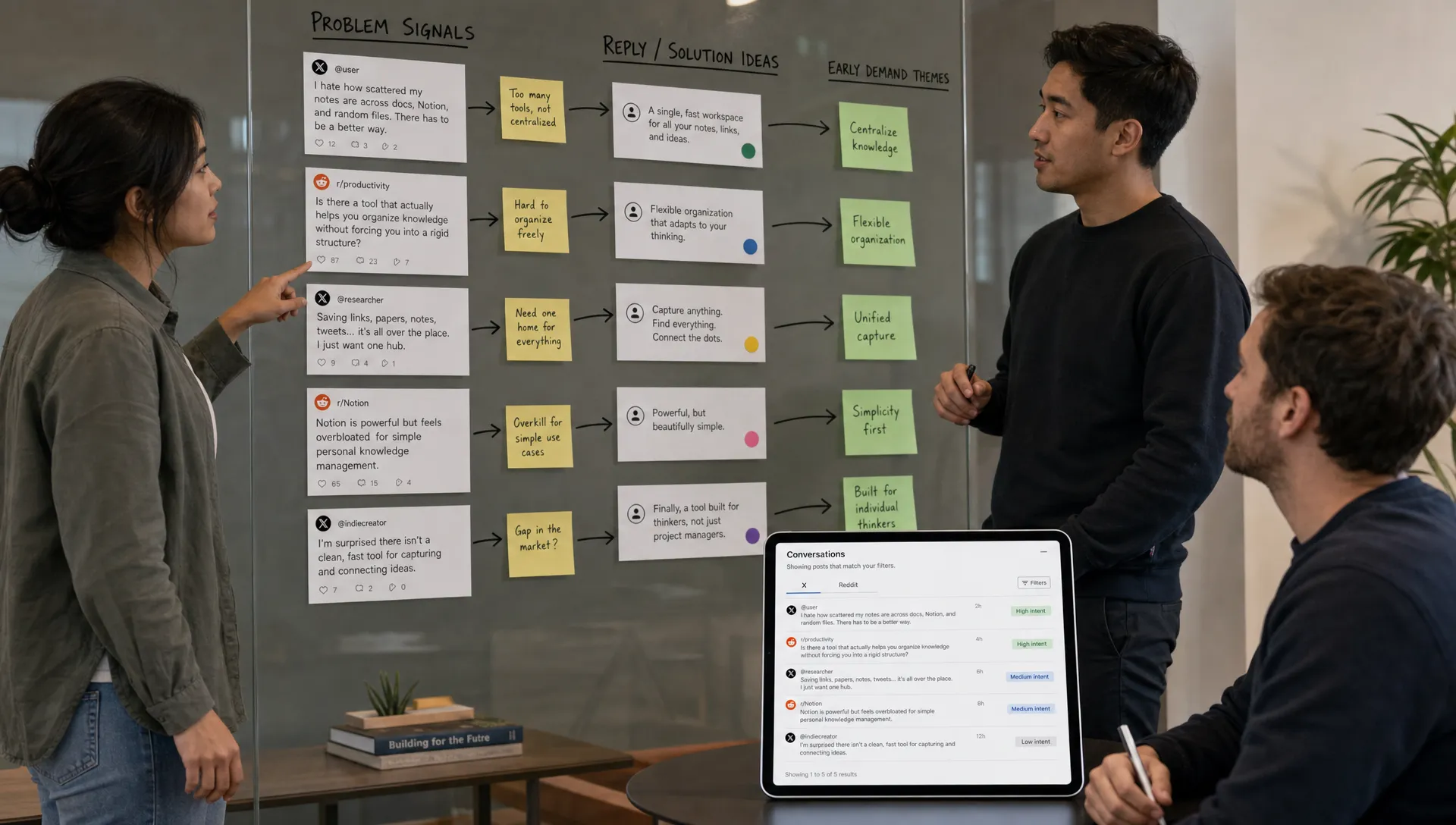
The best inbound signals are already happening without you
Inbound lead generation used to start when someone filled out a form, downloaded a report, or booked a demo. By then, the buyer had already done a lot of thinking. They had felt the pain, searched for options, compared opinions, and asked peers what to try.
Today, much of that early buying journey happens in public. People ask for recommendations on Reddit. They complain about broken workflows on X. They compare tools in comment threads. They share screenshots, objections, budget constraints, migration worries, and exact use cases long before they are ready to talk to sales.
That means the real starting point for inbound is not your landing page. It is the moment a potential buyer says, in public, “Does anyone know how to solve this?”
For founders, marketers, and lean growth teams, this changes the job. You are not just trying to attract traffic. You are trying to notice demand while it is forming, then enter the conversation with enough context to be genuinely useful.
Why public conversations are becoming the new inbound layer
Search is still important. Content is still important. But buyers increasingly use social platforms and communities as trust filters. They do not only want a polished vendor answer. They want lived experience, tradeoffs, warnings, and recommendations from people who sound like them.
That is why X and Reddit are so valuable for inbound. They contain three things most channels struggle to provide at the same time: timing, context, and intent.
Timing matters because a person asking for alternatives today is more actionable than a person who read a blog post six months ago. Context matters because the post usually explains the use case, frustration, tools involved, or decision criteria. Intent matters because the person is not passively consuming content, they are actively trying to make progress.
A traditional inbound funnel often looks like this: publish, rank, capture, nurture, qualify. A conversation-led inbound motion looks different: monitor, identify, help, build trust, then move to the next step only when it makes sense.
This does not replace SEO, email, or paid acquisition. It makes them sharper. The language you hear in public conversations can inform your content strategy, product positioning, objection handling, landing page copy, and sales follow-up.
What high-intent public conversations actually look like
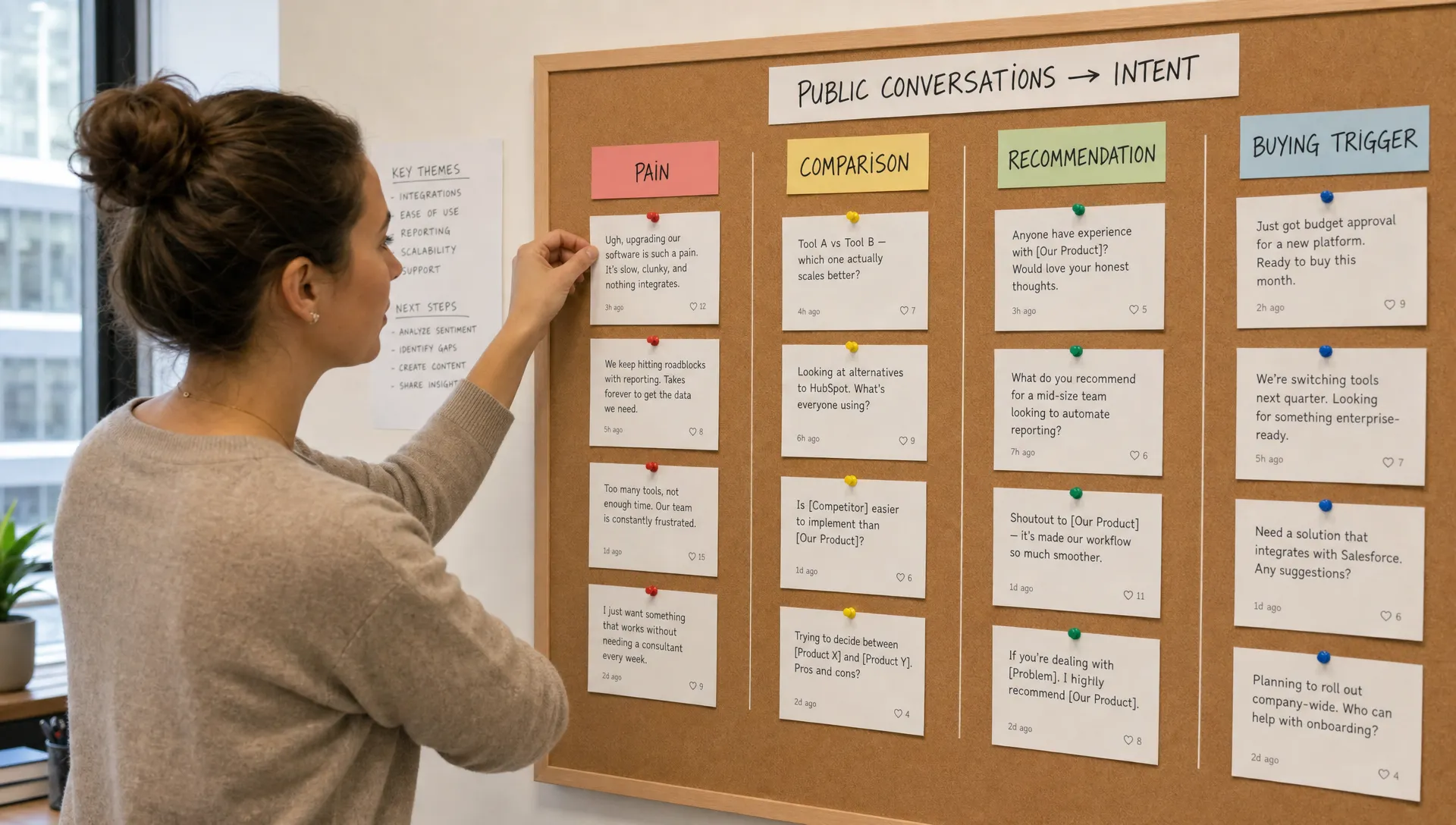
Not every mention is a lead. A viral thread with thousands of views can be useless if nobody has a real problem. A quiet Reddit post with three comments can be valuable if the author clearly describes pain, urgency, and a buying trigger.
The goal is not to chase every keyword. The goal is to recognize patterns of intent.
| Conversation type | What the buyer is really saying | Good response angle |
|---|---|---|
| “What tool should I use for X?” | I am actively evaluating options | Share selection criteria and when your category fits |
| “I hate how our current process works” | I have pain, but may not know the category | Diagnose the workflow and offer a practical next step |
| “Alternatives to [competitor]?” | I am considering switching | Compare tradeoffs without attacking the competitor |
| “How do you solve [specific problem]?” | I need implementation help | Give a useful playbook or example |
| “Is [category] worth it?” | I am skeptical but curious | Explain when it is worth it and when it is not |
This is the core shift: public posts are not just awareness signals. Many are problem statements, buying criteria, and qualification notes written by the prospect themselves.
For example, someone asking “How do I find more B2B leads without cold email?” is not just discussing marketing. They are revealing a channel constraint, a goal, and likely dissatisfaction with their current motion. Someone asking “Any good tools for monitoring Reddit mentions?” is even further along because they already understand the category.
The more specific the post, the more useful your reply can be.
A better mental model: public conversations as inbound demand capture
Inbound lead generation is usually described as attracting people to you. That is true, but incomplete. In a crowded market, you also need to show up where demand is already expressing itself.
This is not outbound in the traditional sense. You are not interrupting a cold prospect with a generic pitch. You are responding to a relevant question, complaint, or comparison that the prospect chose to publish.
The difference is permission. In a public conversation, the person has already invited input. Your job is to make the input worth their attention.
That requires restraint. If your first move is “Book a demo,” you lose trust. If your first move is a thoughtful answer that helps them understand the problem better, you create a path toward a relationship.
This approach works especially well in categories where buyers need education before they can act. For example, music companies and rights holders may first need to understand where their intellectual property is being used before they can enforce rights or unlock licensing revenue, which is the kind of growth problem addressed by an IP enforcement and licensing platform. In those markets, the public question often appears before the formal buying process begins.
How to build an inbound system around X and Reddit
A strong conversation-led inbound system is not “scroll more and hope.” It is a repeatable process for finding, qualifying, and responding to the right posts.
Start with the problems your product solves, not just your product category. Category keywords are useful, but pain keywords often surface earlier intent. If you sell a customer support tool, “help desk software” is category intent. “Drowning in support tickets” is pain intent. If you sell a developer tool, your product name may appear rarely, but the error messages, workflow complaints, and competitor limitations may appear every day.
Then map those problems to the words buyers actually use. Public conversations are valuable because they are messy. People do not speak in landing page copy. They say things like “this is taking forever,” “our current setup is duct taped,” “I cannot justify another tool,” or “we need something lightweight.”
Once you have the language, define what counts as a good lead. A useful rule is to score posts on three dimensions: relevance, urgency, and ability to help.
| Signal | Strong indicator | Weak indicator |
|---|---|---|
| Relevance | The post describes a problem your product directly solves | The post only mentions a broad topic |
| Urgency | The author is choosing, switching, or fixing now | The author is casually curious |
| Ability to help | You can give a specific, credible answer | You can only reply with a pitch |
This is where tools like Pounce fit naturally. Pounce monitors X and Reddit in real time, filters for relevant conversations, and helps you work from an inbox of posts instead of manually searching across platforms. If you want the broader channel strategy, the Pounce guide to a lead generation strategy for X and Reddit in 2026 expands on how to turn these platforms into a daily growth habit.
The 15-minute daily workflow
Conversation-led inbound works best when it becomes a short, consistent routine. Long, unfocused browsing sessions create fatigue. A daily sprint creates momentum.
Here is a simple workflow for a focused session:
- Review surfaced posts from X and Reddit that match your search rules.
- Open only the posts with clear pain, urgency, or category fit.
- Write helpful replies that address the specific question before mentioning your product.
- Save promising conversations for follow-up if the author responds.
- Note recurring phrases, objections, and use cases for future content.
This is not about volume for its own sake. Fifteen thoughtful replies to high-intent conversations can be more valuable than a hundred generic comments. The goal is to become visible in the exact places where your buyers are already asking for help.
Pounce is built around this kind of focused session: real-time monitoring, AI-powered filtering, reply drafting assistance, customizable search rules, and daily reply goals. The point is not to automate your personality away. It is to remove the manual search work so you can spend your time on the part that matters, saying something useful.
How to reply without sounding like a spammer
The fastest way to ruin a public conversation is to treat it like an ad slot. People can tell when you did not read the post. They can also tell when your “helpful answer” is just a setup for a link.
Good replies usually follow a simple structure. First, reflect the problem in the poster’s language. Second, offer a concrete insight, checklist, or tradeoff. Third, mention your product only if it is genuinely relevant, and frame it as one option rather than the only answer.
For example, a weak reply says: “We solve this. DM me.”
A better reply says: “If the issue is finding relevant conversations before they get stale, I’d separate your tracking into category terms, pain terms, and competitor terms. Category terms catch people already shopping. Pain terms catch people earlier. Competitor terms catch switchers. We built Pounce for this exact workflow, but you can test the motion manually first with saved searches to see if the signal is there.”
The second reply teaches something. It gives the reader a way to think. It earns the product mention.
Reddit requires extra care because community norms vary widely. Some subreddits welcome practitioner advice. Others remove anything that feels commercial. Before replying, look at the rules, read top comments, and match the depth of the community. If Reddit is a core channel for you, Pounce has a focused guide on how to turn a Reddit post into qualified leads without forcing the conversation.
X has different dynamics. Speed matters more because threads move quickly, and the reply graph can reward early, useful participation. The best opportunities often come from replying to people with relevant audiences, not only to direct prospects. Pounce’s reply-first strategy for growing on X covers that distribution angle in more detail.
When a public conversation becomes a lead
A public reply is only the beginning. The lead emerges when the person engages, asks a follow-up question, shares more context, or indicates that they are actively looking for a solution.
Do not rush the handoff. If someone replies with “Interesting, how would you set this up?” keep helping in public if the answer benefits others. If they share private details like budget, team size, internal blockers, or data access, then it may be appropriate to move to DM or suggest a call.
A useful transition sounds like this: “Happy to keep answering here, but if you want to share your current setup, I can suggest a more specific approach over DM.”
That is different from pushing a meeting immediately. It respects the conversation and lets the buyer choose the next step.
The best inbound teams track these moments carefully. A post can become a reply, a reply can become a conversation, a conversation can become a qualified opportunity, and the language from that journey can improve your entire go-to-market motion.
What to measure beyond clicks and demos
If you only measure demos booked, you will miss the compounding value of public conversations. Some of the return is immediate, but much of it comes from learning and visibility.
Track both pipeline metrics and learning metrics.
| Metric | Why it matters |
|---|---|
| Relevant posts found | Shows whether your monitoring rules are capturing the right market conversations |
| Replies sent | Measures consistency and daily participation |
| Response rate | Shows whether your replies are useful enough to earn engagement |
| Conversations started | Indicates relationship momentum beyond one-off comments |
| Qualified opportunities | Connects the motion to revenue potential |
| Repeated objections | Improves sales copy, content, and product messaging |
| Repeated use cases | Reveals segments worth targeting more directly |
The learning metrics are especially important for early-stage companies. If ten prospects describe the same pain in ten different threads, that is not just lead generation. It is market research. If people repeatedly reject a category because of price, setup time, trust, or complexity, that is positioning input.
The content advantage hidden inside public conversations
Conversation-led inbound does not end with the reply. Every useful thread can become a seed for content.
A Reddit post asking how to choose between two approaches can become a comparison article. A recurring X complaint can become a tactical guide. A skeptical comment can become an FAQ entry on your landing page. A detailed objection can become a sales enablement note.
This is how public conversations strengthen SEO instead of competing with it. Search content often performs best when it mirrors the real language of buyers. Public platforms give you that language before keyword tools fully catch up.
For example, keyword research might tell you that “inbound lead generation” has search demand. Public conversations tell you what people actually mean when they search it: “I need leads without cold outreach,” “I want warmer conversations,” “I do not have time to post every day,” “I want prospects who already know they have the problem.”
That nuance makes your content more specific, and specificity is what earns trust.
Why this works for lean teams
Large companies can buy attention. Smaller teams usually need to earn it. Public conversations are one of the few channels where a sharp, timely answer can put a small team beside much larger competitors.
You do not need a huge audience to be useful in someone else’s thread. You do not need a massive content engine to answer a timely question. You do not need a complex funnel to start a relationship with a person who just described a problem you understand deeply.
That is why this motion is so practical for founders, agencies, consultants, and B2B teams with limited time. A small number of daily, high-quality interactions can create distribution, pipeline, and learning at the same time.
The key is consistency. One week of replies may create a few conversations. Three months of focused participation can create category recognition. People start seeing your name in useful contexts. They remember the practical answer. They tag you when someone asks a related question.
That is inbound at its best: not passive waiting, but trusted visibility built through relevance.
FAQ
Is replying to public conversations inbound or outbound?
It sits between the two, but it behaves more like inbound when done well. You are not interrupting a random person. You are responding to someone who publicly asked a relevant question or described a problem. The key is to lead with help, not a cold pitch.
Which platform is better for inbound lead generation, X or Reddit?
It depends on your market. Reddit is often stronger for detailed problem discussions, tool comparisons, and peer recommendations. X is often stronger for speed, visibility, founder-led distribution, and timely replies. Many teams get the best results by monitoring both.
How do I know if a post is high intent?
Look for specificity. A high-intent post usually includes a clear problem, current tool or workflow, urgency, budget or decision constraints, or a request for recommendations. Generic mentions of a topic are usually lower intent.
Should I link to my product in every reply?
No. In many cases, the best first reply does not need a link. Answer the question, explain the tradeoffs, and mention your product only when it naturally fits. Over-linking can reduce trust, especially on Reddit.
How often should a small team do this?
A focused 15-minute session each weekday is enough to start. The goal is to build a repeatable habit: review relevant posts, reply thoughtfully, follow up when people engage, and capture insights for future content and positioning.
Start where your buyers are already talking
Inbound lead generation is no longer limited to forms, gated assets, and search traffic. Those still matter, but the earliest demand signals often appear in public conversations first.
If your buyers are asking questions on X and Reddit, you do not need to wait until they discover you later. You can show up now with a useful answer, learn from the market in real time, and build relationships before the buying process becomes crowded.
Pounce helps you find those moments faster by monitoring X and Reddit for relevant, high-intent conversations, then giving you a focused inbox so you can reply, build trust, and grow your distribution one helpful conversation at a time.