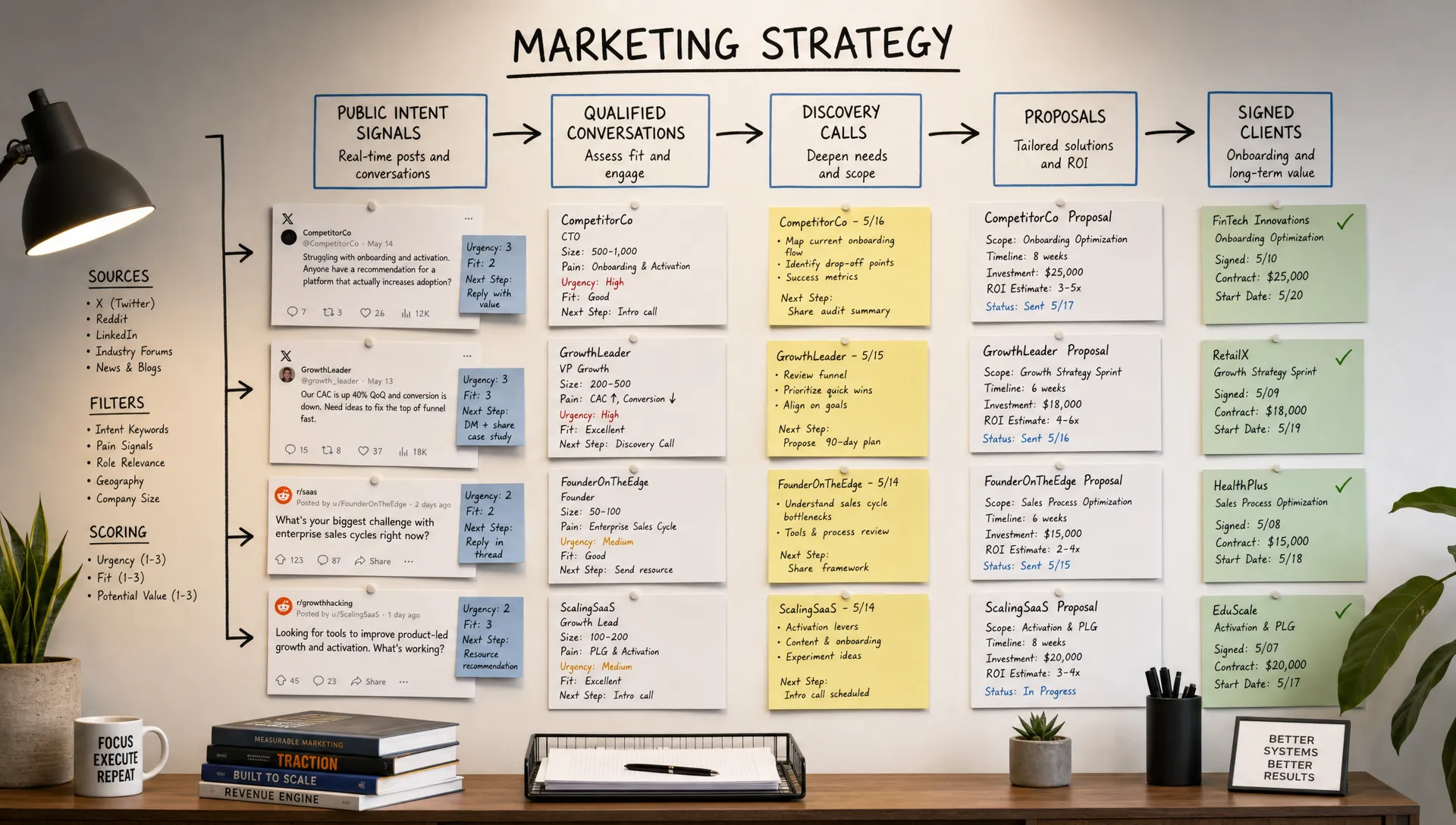
Why agency pipeline breaks when you rely on momentum
Most marketing agencies do not have a lead problem all the time. They have a pipeline consistency problem. One month, referrals come in, a past client introduces you to a founder, and a content post gets attention. The next month, the inbox is quiet, deals stall, and the team starts debating whether to run ads, send cold DMs, or hire an SDR.
That feast-or-famine cycle is especially common for agencies because the buying moment is narrow. Prospects usually reach out when something is already painful: CAC is rising, the website is not converting, paid campaigns are underperforming, growth has plateaued, or the founder is finally ready to outsource a function they have been duct-taping internally.
The best lead generation for marketing agencies is not about broadcasting harder. It is about finding those moments earlier, joining the conversation while the buyer is still forming their shortlist, and proving useful before you ask for a call.
What makes lead generation for marketing agencies different
Selling agency services is not the same as selling software. Buyers are not just evaluating features or price. They are evaluating trust, taste, strategic judgment, communication style, category experience, and whether your team can make their problem feel less risky.
That changes the lead generation motion. A generic list of companies in your niche is not enough. A founder at a SaaS company might technically match your ICP, but if they are not feeling an urgent marketing problem, your pitch lands as noise. A smaller company asking Reddit how to fix poor demo quality, however, may be a better lead than a much larger company with no visible intent.
For agencies, strong lead signals often look like public questions, complaints, comparisons, hiring debates, or requests for recommendations. Examples include:
- A founder asking why their landing page traffic is not converting.
- A head of growth looking for a performance marketing audit.
- A B2B SaaS team comparing SEO agencies in a specific niche.
- A solo founder asking whether to hire in-house or outsource content.
- A marketing lead posting that their current agency is not moving fast enough.
- An operator asking for tools, workflows, or specialists to solve a bottleneck.
This is why agency pipeline often improves when you shift from broad prospecting to intent-led conversation discovery. If you want a deeper playbook on non-interruptive acquisition, Pounce has a guide on generating leads without ads or cold DMs that pairs well with this approach.
Start with pipeline math, not channel opinions
Before choosing tactics, get clear on the numbers. Many agencies jump between LinkedIn, X, Reddit, referrals, partnerships, newsletters, paid search, and outbound because they have not defined how many qualified conversations they actually need.
A simple pipeline model looks like this:
| Pipeline input | What to define | Why it matters |
|---|---|---|
| Average deal value | Retainer, project fee, or blended value | Sets how many wins you need to hit revenue goals |
| Close rate | From qualified call to signed client | Shows whether the bottleneck is sales or lead quality |
| Call booking rate | From conversation to discovery call | Reveals whether your replies and CTAs are working |
| Qualified conversation rate | From lead signal to meaningful exchange | Measures targeting quality |
| Weekly lead signals | Relevant posts, questions, referrals, intros, or inbound forms | Shows whether the top of funnel is healthy |
If your agency needs two new retainers per quarter, the solution may not be thousands of prospects. It may be 20 to 40 high-quality conversations with people who are visibly dealing with the exact problem you solve.
That framing matters because it makes pipeline feel operational. Instead of asking, which channel should we try this month, you can ask, where can we reliably find five to ten relevant buying conversations each week?
Define the problem you want to be found for
A marketing agency that says it helps brands grow has to compete with everyone. An agency that helps B2B SaaS teams fix demo quality after a traffic spike is easier to remember, refer, and buy.
Your lead generation system should begin with a narrow problem statement. Not because your agency can only do one thing, but because prospects recognize themselves faster when your positioning mirrors their pain.
Strong agency problem statements usually include four parts:
| Positioning element | Weak version | Stronger version |
|---|---|---|
| Audience | Startups | Seed to Series B B2B SaaS teams |
| Pain | Need more leads | Traffic is growing but demo quality is falling |
| Outcome | Better marketing | More qualified demos from existing demand |
| Proof angle | We do growth | We diagnose conversion leaks across content, landing pages, and lifecycle emails |
The same logic applies across agency categories. A paid media agency can focus on brands with rising CAC after scaling spend. A content agency can focus on founder-led SaaS teams that need bottom-of-funnel pages. A conversion agency can focus on high-traffic sites with low trial starts. An AI or automation-focused agency can focus on teams with manual workflows and unclear adoption paths. For example, positioning around AI audits, training, and custom solutions can make a broad AI capability feel much more concrete because it ties the offer to productivity, enablement, and implementation.
The more specific the problem, the easier it becomes to monitor public conversations for intent. You are not looking for everyone who might need marketing someday. You are looking for the people describing the pain you solve in their own words.
Build search rules around buyer language
The mistake most agencies make with social listening is monitoring category keywords only. If you are an SEO agency, tracking SEO agency will surface competitors, job posts, vendor lists, and low-intent noise. If you are a conversion agency, tracking conversion rate may surface educational chatter instead of buying moments.
Better search rules combine problem language, role context, urgency, and action words.
For example, an agency that helps SaaS companies improve demo conversion might monitor phrases like:
- Why are our demos not converting
- Lots of traffic no signups
- Landing page feedback SaaS
- Need help with onboarding emails
- Looking for B2B SaaS conversion expert
- Best agency for SaaS landing pages
- Should we hire a growth agency
On X, these signals often appear as short, high-context posts from founders, marketers, and operators. On Reddit, they often appear as longer questions with more background, objections, and constraints. Both are valuable, but they require different reply styles.
A tool like Pounce can help by monitoring X and Reddit in real time, filtering posts with AI, and putting relevant conversations into an inbox so you are not manually refreshing feeds. The key is still strategic input: your search rules should reflect the buyer's language, not just your service category.
For a more detailed look at timing and signal capture, see Pounce's article on why real-time monitoring is often the shortcut to better leads.
Score intent before you reply
Not every relevant post deserves your time. Marketing agencies need a lightweight qualification system so they can move fast without replying to every vague mention of their category.
Use a simple intent score before engaging:
| Signal | Low intent | Medium intent | High intent |
|---|---|---|---|
| Pain clarity | General curiosity | Specific frustration | Clear business problem with stakes |
| Buyer fit | Unknown audience | Adjacent ICP | Matches your best client profile |
| Urgency | Learning someday | Exploring options | Needs help now or soon |
| Authority | Student, vendor, or observer | Team member researching | Founder, operator, or decision influencer |
| Openness | Ranting only | Asking for advice | Asking for recommendations or next steps |
A founder saying, anyone know a good lifecycle email person for B2B SaaS, is very different from a marketer sharing a generic article about email strategy. Both mention your category. Only one is likely to turn into pipeline soon.
Reply like an expert, not a vendor
The fastest way to ruin a high-intent conversation is to jump straight into a pitch. Public conversations reward usefulness. If your first reply sounds like a sales script, the prospect will often ignore it, and the community may downvote or challenge it.
A strong agency reply usually has four parts: acknowledge the problem, offer a diagnosis, give one practical next step, and only then create a path to continue.
Here is a simple structure:
| Reply part | Purpose | Example language |
|---|---|---|
| Acknowledge | Show you understood the situation | This usually happens when traffic quality and page intent are mismatched. |
| Diagnose | Add expertise without overexplaining | I would check whether the page is attracting research queries but asking for a demo too early. |
| Help | Give a useful next step | Compare demo requests by source and query type before changing the page copy. |
| Invite | Offer a low-pressure next step | Happy to share a quick checklist if useful. |
This style works because it demonstrates judgment. You are not saying, hire us. You are showing how you think.

Run a 15-minute daily pipeline session
Agency founders often avoid lead generation because it feels like a giant task. The better habit is a short daily session with a clear target. Fifteen focused minutes can be enough if the system is already surfacing relevant conversations.
A practical daily routine looks like this:
- Review new signals for three minutes: Open your inbox of relevant X and Reddit posts, then remove anything that is off-topic, too old, or clearly low intent.
- Qualify for five minutes: Score posts based on ICP fit, urgency, authority, and whether you can add a useful perspective.
- Reply for five minutes: Write helpful, specific replies that diagnose the issue and give one next step. Use AI-assisted drafting for speed, but edit for voice and context.
- Log patterns for two minutes: Track repeated pains, objections, and phrases that could become content, landing page copy, or sales call questions.
Pounce is built around this kind of workflow: real-time X and Reddit monitoring, AI-powered filtering, customizable search rules, reply drafting, daily reply goals, and session stats. The point is not to automate relationships. The point is to reduce the time between buyer intent and your useful response.
If your team can repeat that process five days a week, lead generation becomes less dependent on motivation. It becomes a pipeline habit.
Turn conversations into agency assets
The hidden benefit of intent-led lead generation is market research. Every qualified conversation tells you what buyers are struggling with, what language they use, what alternatives they are considering, and what makes them hesitate.
That intelligence should feed the rest of your agency growth system.
A Reddit thread about poor landing page conversion can become a teardown post. A founder's complaint about agency reporting can become a sales deck slide about your communication cadence. A repeated question about whether to hire in-house or outsource can become a comparison page. A common objection about price can become a case study section explaining opportunity cost.
This is where many agencies leave money on the table. They treat lead generation as isolated outreach instead of a feedback loop. The best agencies use conversations to sharpen their offer, improve content, and make sales calls feel familiar before they happen.
Add channels without losing focus
X and Reddit are powerful because they expose public intent, but they should not be your only pipeline sources forever. Once your agency knows which pains convert, you can extend the same signal-based approach into other channels.
Partnerships work well when another service provider reaches the same buyer before or after you. A web development studio might refer clients to a conversion agency after launch. A fractional CMO might refer execution work to a paid media or content team. A CRM consultant might refer lifecycle email needs.
Content works better when it answers the same questions buyers ask in public. Instead of publishing generic thought leadership, write pages and posts around high-intent problems: why demo requests are low quality, how to know if paid spend is capped by creative, what to audit before hiring an SEO agency, or when a founder should stop doing content alone.
Referrals become more predictable when you give partners a clear trigger. Do not say, send us anyone who needs marketing. Say, send us B2B SaaS teams with traffic but not enough qualified demos.
The channel mix can expand, but the core stays the same: specific pain, visible intent, useful response, clear next step.
Measure the quality of your pipeline system
Lead generation for marketing agencies should be measured by learning and revenue potential, not vanity activity. A week with ten thoughtful replies to high-intent prospects is usually better than a week with 200 generic DMs.
Track metrics that tell you whether the system is improving:
| Metric | What it reveals | How to use it |
|---|---|---|
| Relevant posts found | Search rule quality | Refine keywords, exclusions, and platforms |
| Qualified replies sent | Team consistency | Set daily or weekly reply goals |
| Conversation rate | Reply quality | Improve specificity and reduce pitching |
| Calls booked | CTA strength | Test softer or more direct next steps |
| Lead source patterns | Channel performance | Double down on communities and phrases that convert |
| Repeated objections | Offer clarity | Update content, proposals, and sales scripts |
Session stats matter because they make the work visible. If your team sees that a 15-minute session produced three qualified replies and one conversation, the habit becomes easier to maintain. If the inbox is full of irrelevant posts, you know the search rules need work rather than blaming the channel.
Common mistakes agencies should avoid
The first mistake is chasing broad keywords. Terms like marketing help, growth, or agency can produce too much noise. Start with the exact pain your best clients had before they hired you.
The second mistake is replying too late. Public buying intent has a short shelf life. If ten people have already responded with recommendations, your agency is now one of many. Speed matters, especially when the prospect is actively asking for help.
The third mistake is pitching before earning attention. A helpful reply can turn into a DM, call, or referral. A pitch disguised as advice usually ends the conversation.
The fourth mistake is hiding your affiliation. This matters especially on Reddit, where communities are sensitive to self-promotion. Be transparent when relevant, contribute value first, and respect subreddit rules.
The fifth mistake is treating AI as a replacement for expertise. AI can help monitor, filter, draft, summarize, and improve workflows. It cannot decide your positioning, replace your strategic judgment, or build trust on your behalf.
A simple pipeline plan for the next 30 days
If your agency needs pipeline now, keep the first month focused. Do not rebuild your entire go-to-market system. Build one repeatable motion.
In week one, define your best-fit client profile and choose one painful problem to monitor. Write ten to fifteen search phrases based on how buyers describe that problem, not how your agency describes its services.
In week two, start daily monitoring and reply only when you can add a useful diagnosis. Track which posts feel qualified, which replies get engagement, and which phrases appear repeatedly.
In week three, tighten your offer based on what you are seeing. If buyers keep asking for audits, package an audit. If they keep asking whether to hire in-house, create a decision guide. If they keep comparing vendors, clarify your point of view.
In week four, connect the motion to sales. Add soft CTAs, create a simple follow-up process, and turn the best conversation themes into content or landing page sections.
By the end of 30 days, you should know which signals are worth pursuing, which replies earn trust, and whether the channel can support your pipeline goals.
FAQ
What is the best lead generation strategy for marketing agencies?
The best strategy is usually a mix of referrals, authority content, partnerships, and intent-led conversation discovery. For agencies that need pipeline sooner, monitoring public conversations on X and Reddit can be especially useful because prospects are already describing problems, asking for recommendations, or comparing options.
How can a marketing agency generate leads without cold DMs?
Start by finding public posts where your ideal buyers are asking for help. Reply with a useful diagnosis, share one practical next step, and invite a deeper conversation only when it is relevant. This feels more natural than cold DMs because the buyer has already opened the conversation.
How many leads does an agency need each month?
It depends on average deal value, close rate, and capacity. A small specialist agency may only need a handful of qualified sales calls per month to stay healthy. The better question is how many high-intent conversations you need each week to create enough qualified calls.
Should agencies use AI for lead generation?
Yes, if AI is used to improve focus and speed. AI can monitor conversations, filter noise, draft replies, and help identify repeated pain patterns. The agency still needs to bring positioning, judgment, and human relationship-building.
Is Reddit a good channel for agency lead generation?
Reddit can be valuable when you respect the culture of each community. It works best for agencies that answer honestly, avoid spam, disclose relevant affiliation, and contribute useful expertise before suggesting a call or service.
Build pipeline from the conversations already happening
If your agency needs pipeline, the answer is not always more ads, more cold outreach, or more generic content. Often, the fastest improvement comes from finding the right conversations while they are still active and responding with real expertise.
Pounce helps agencies monitor X and Reddit in real time, surface high-intent leads, draft better replies, and stay consistent with quick daily sessions. Use it to turn public buyer intent into a repeatable pipeline habit, one useful reply at a time.