Better leads are usually a timing problem
Most teams do not have a lead problem because the internet is empty. They have a lead problem because they arrive too late, too broadly, or with too little context.
By the time someone fills out a demo form, downloads a gated guide, or appears in a purchased database, the buying journey is already well underway. They have asked peers for recommendations. They have complained about a workflow. They have compared tools. They may have even named your competitors in public.
That is why real-time monitoring is such a powerful shortcut. It helps you find people while the problem is active, not weeks after the signal has gone cold.
For lean teams, founders, agencies, and marketers who cannot afford to waste hours combing through X and Reddit manually, the advantage is simple: show up when the conversation is still alive.
What real-time monitoring actually means
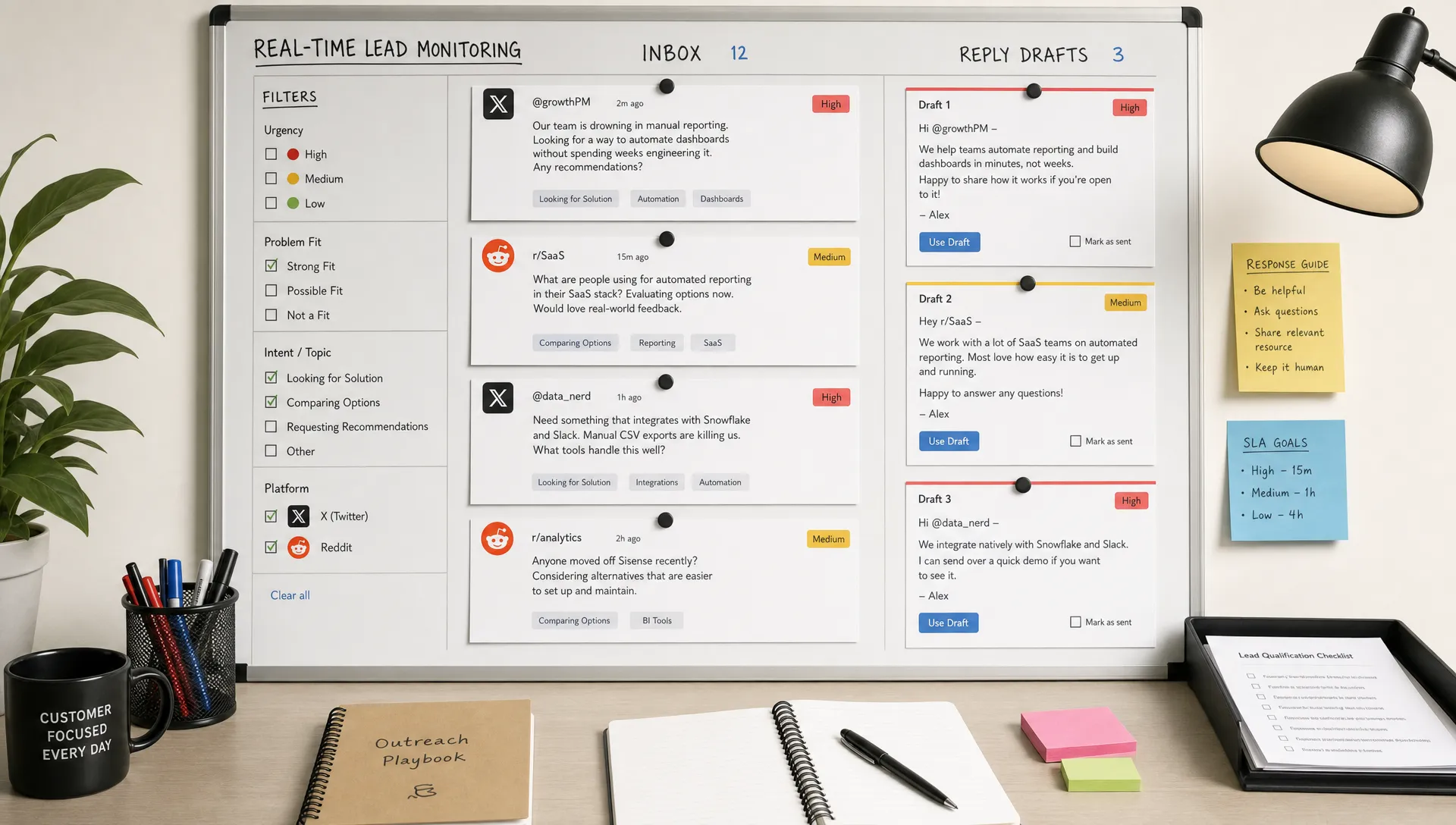
Real-time monitoring is not the same thing as checking social media all day. It is a system for tracking specific keywords, phrases, communities, accounts, and pain signals as they appear, then filtering those mentions for relevance.
On X and Reddit, that can include posts like:
- “What are people using for cold email alternatives?”
- “Anyone know a tool that monitors Reddit for brand mentions?”
- “We are struggling to find high-intent leads without paid ads.”
- “Is there a better way to find conversations before competitors do?”
- “Looking for recommendations for a lightweight lead gen workflow.”
A human can search for these manually, but manual search has a built-in delay. You remember to look after the thread has peaked. You miss the specific phrasing your buyers use. You spend time reading noise instead of replying to opportunities.
Real-time monitoring compresses that work. It surfaces the posts that match your rules, applies relevance filters, and gives your team a cleaner inbox of conversations worth reviewing.
| Approach | What happens | Lead quality impact |
|---|---|---|
| Static lead list | You contact people based on firmographics or old data | Often cold, broad, and context-light |
| Manual social search | You look for relevant posts when you remember | Useful, but inconsistent and slow |
| Real-time monitoring | Relevant conversations are surfaced as they happen | Timely, contextual, and intent-driven |
The key is not simply moving faster. It is moving faster with better context.
Why speed changes the conversation
When someone posts a question on Reddit or X, the first useful replies often shape the direction of the thread. If you arrive early with a thoughtful answer, you are not interrupting. You are participating.
That timing matters because public conversations are different from cold outbound. The person has already raised their hand. They may not have asked for a demo, but they have revealed a need, frustration, comparison, or buying question.
A helpful reply in that moment can do three things at once. It can answer the original question, show expertise to everyone reading, and create a natural reason for the buyer to continue the conversation.
This is why real-time monitoring pairs so well with a reply-first growth motion. Instead of posting into the void and hoping the right person sees it, you find the right conversation and add value where attention already exists. If you want a deeper breakdown of that approach, Pounce’s guide to growing on X with a reply-first strategy explains why replies can outperform original posts for smaller accounts.
The signals worth monitoring on X and Reddit
Not every mention deserves a reply. Real-time monitoring becomes powerful when you know which signals separate curiosity from commercial intent.
The highest-value signals usually fall into a few categories.
Problem statements are posts where someone describes pain in their own words. These are often better than keyword-perfect posts because they reveal urgency. For example, “I’m tired of spending hours prospecting manually” is more meaningful than a generic mention of “lead generation.”
Tool comparisons show active evaluation. If someone is asking how one product compares to another, they are usually closer to a decision than someone reading a beginner guide.
Recommendation requests are direct opportunities to help. These threads often attract multiple vendors, so the best reply is not “use us.” It is a clear answer that helps the person choose well.
Workflow questions reveal use cases. A post asking “How do you track Reddit mentions for sales?” may be more valuable than a direct “best monitoring tool” query because it exposes the job they need done.
Competitor frustration can be useful, but it requires restraint. If someone complains about a tool, do not pile on. Acknowledge the frustration, explain the tradeoff, and offer a practical alternative if relevant.
The best monitoring rules combine obvious keywords with buyer language. Instead of tracking only “lead gen,” you might track phrases like “find leads on Reddit,” “monitor X mentions,” “alternatives to cold DMs,” or “where do I find buyers for.”
The shortcut is relevance, not volume
A common mistake is treating real-time monitoring like a bigger net. More alerts, more keywords, more mentions, more replies. That quickly turns into noise.
The better approach is to use monitoring as a relevance engine. Your goal is not to reply to every post that mentions your category. Your goal is to identify the few conversations where your experience, product, or perspective genuinely fits.
That is especially important on Reddit, where communities are quick to reject obvious self-promotion. It also matters on X, where generic replies are easy to ignore. In both places, the standard is the same: add something useful before asking for anything.
If your team is building a non-spammy pipeline, this distinction matters. Pounce has a full guide on lead generation that feels helpful, not pushy, and the core principle applies here too: the buyer’s context should drive the reply.
A practical real-time monitoring workflow
The simplest workflow is the one your team can actually repeat. You do not need a massive social command center. You need a short daily habit that turns public intent into qualified conversations.
Here is a practical sequence for a 15-minute session.
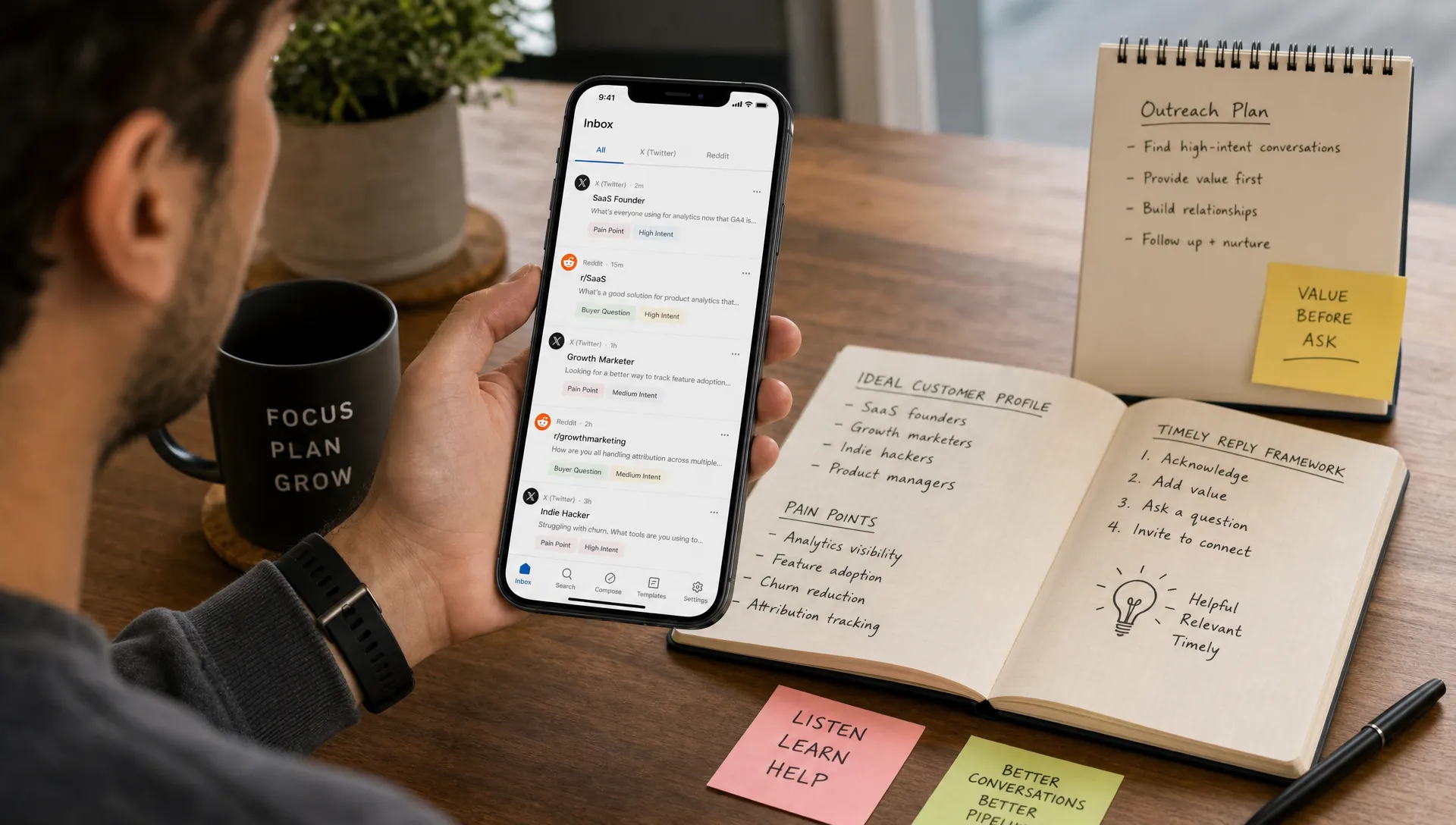
- Review your highest-intent inbox first: Start with posts that match buying phrases, comparison terms, recommendation requests, or urgent pain points.
- Score the conversation before replying: Ask whether the person matches your ICP, whether the problem is current, and whether you can add a genuinely useful answer.
- Draft a contextual reply: Reference the specific situation in the post. Avoid templates that could apply to anyone.
- Lead with help, not a pitch: Share a practical suggestion, question, example, or tradeoff before mentioning your product.
- Track what happens: Note which rules surfaced good leads, which replies got responses, and which signals were too noisy.
That last step is where the workflow compounds. Over time, your team learns which phrases indicate real buying intent and which ones merely generate activity.
Pounce is built around this operating rhythm: AI monitors X and Reddit, filters for relevant conversations, helps draft replies, and gives you an inbox for posts worth engaging. Features like customizable search rules, daily reply goals, session stats, and automatic filter improvement support a repeatable habit rather than a one-off prospecting sprint.
How to write replies that convert without feeling automated
Real-time monitoring gets you to the conversation. The reply still has to earn trust.
A strong reply usually has four parts. First, it acknowledges the exact problem. Second, it gives a useful answer even if the person never becomes a customer. Third, it adds a perspective that is hard to get from a generic search result. Fourth, if appropriate, it offers a light next step.
For example, if someone asks how to find leads without cold DMs, a weak reply says, “Use our tool.” A better reply says something like:
“Cold DMs are tough if the person has not shown intent yet. I’d start by monitoring public posts where people are already asking for recommendations or describing the problem you solve. On Reddit, look for phrases like ‘anyone using,’ ‘alternatives to,’ and ‘how do you handle.’ If you want to make it repeatable, you can set up rules so those posts come to you instead of searching manually.”
That answer helps whether or not the person clicks through. It also creates a natural opening if they ask what tool you use.
For more tactical examples, the Pounce article on marketing lead generation without ads or cold DMs goes deeper into using public conversations as a warmer alternative to interruption-based outreach.
Where real-time monitoring fits in the broader pipeline
Real-time monitoring is not a replacement for every other channel. It is an intent layer that can improve the timing and relevance of the rest of your pipeline.
For early-stage teams, it can be the fastest path to learning buyer language. You see the exact words people use before those words appear in sales calls, surveys, or keyword tools.
For growth teams, it can feed content ideas, sales enablement, competitive insights, and community engagement. A single Reddit thread can reveal a positioning gap. A cluster of X posts can show that a new pain point is emerging in your market.
For account-based teams, monitoring can also trigger thoughtful follow-up across channels. If a target account is discussing a problem publicly, that signal can inform email, sales outreach, or even offline campaigns. Teams that use direct mail as part of a broader motion may connect those insights to an all-in-one platform like DirectMail.io when they need data, design, postal workflow, automation, and reporting in one place.
The common thread is context. The better your inputs, the better every downstream touchpoint becomes.
Metrics that show your monitoring is working
Real-time monitoring should produce more than a busy inbox. If it is working, you should see better conversations, faster replies, and clearer learning loops.
Track a few simple metrics instead of drowning in dashboards.
| Metric | Why it matters | What to look for |
|---|---|---|
| Relevant posts found | Shows whether your rules match real conversations | A steady flow of posts your team would actually reply to |
| Reply rate | Measures whether your responses earn engagement | More comments, DMs, or follow-up questions |
| Qualified conversations | Connects social engagement to pipeline quality | People who match your ICP and have a current need |
| Rule quality | Shows whether monitoring is improving | Fewer noisy alerts and more high-intent matches over time |
| Time to reply | Measures whether you are catching threads early | Shorter delay between post discovery and response |
Do not over-optimize for impressions. A reply seen by 200 relevant people can be more valuable than a generic post seen by 20,000 random ones.
Common mistakes that make real-time monitoring noisy
The first mistake is using keywords that are too broad. If you monitor “marketing,” “SaaS,” or “sales,” you will spend most of your time filtering junk. Start with narrow phrases tied to buying moments, then expand carefully.
The second mistake is replying to posts that are technically relevant but socially wrong. A frustrated rant, a closed community discussion, or a thread with strict self-promotion rules may not be the right place to mention your product.
The third mistake is over-automating the human part. AI-assisted drafting can save time, but the final reply should still sound like someone read the post. Mention the specific detail that made the conversation relevant.
The fourth mistake is quitting too early. Monitoring improves as your rules improve. The first week tells you where the noise is. The second and third weeks reveal which phrases, subreddits, accounts, and competitor mentions consistently produce better leads.
FAQ
What is real-time monitoring for lead generation?
Real-time monitoring for lead generation is the process of tracking live conversations, mentions, keywords, and buying signals so your team can respond while interest is active. On X and Reddit, it helps you find people asking questions, comparing tools, or describing problems related to what you sell.
Why is real-time monitoring better than a static lead list?
A static lead list tells you who might fit your market. Real-time monitoring shows who is actively talking about a relevant problem right now. That timing gives your reply more context and makes the conversation feel more helpful than cold outreach.
Can real-time monitoring work for small teams?
Yes. Small teams often benefit the most because they cannot afford to waste time on low-intent prospecting. A focused 15-minute daily workflow can surface a manageable number of high-quality conversations to review and reply to.
How do you avoid sounding spammy when replying to monitored posts?
Lead with the person’s problem, not your product. Give a useful answer, reference the specifics of their post, and only mention your product when it is clearly relevant. If the reply would not be helpful without the product mention, rewrite it.
Which platforms are best for real-time lead monitoring?
X and Reddit are especially useful because buyers often ask questions, compare options, and describe frustrations publicly. X tends to move quickly, while Reddit often contains deeper context and more detailed discussions.
Turn live conversations into better leads
Real-time monitoring is not about chasing every mention on the internet. It is about finding the moments where your buyer is already asking, comparing, struggling, or deciding, then showing up with something useful.
That is the shortcut: fewer cold guesses, more timely conversations.
Pounce helps you build that habit in short, focused sessions. It monitors X and Reddit in real time, filters for high-intent conversations, helps draft replies, and keeps your team focused on the posts most worth answering.
If your pipeline needs more relevance and less noise, start with the conversations already happening. Spend 15 minutes with Pounce and get in front of the right people sooner.