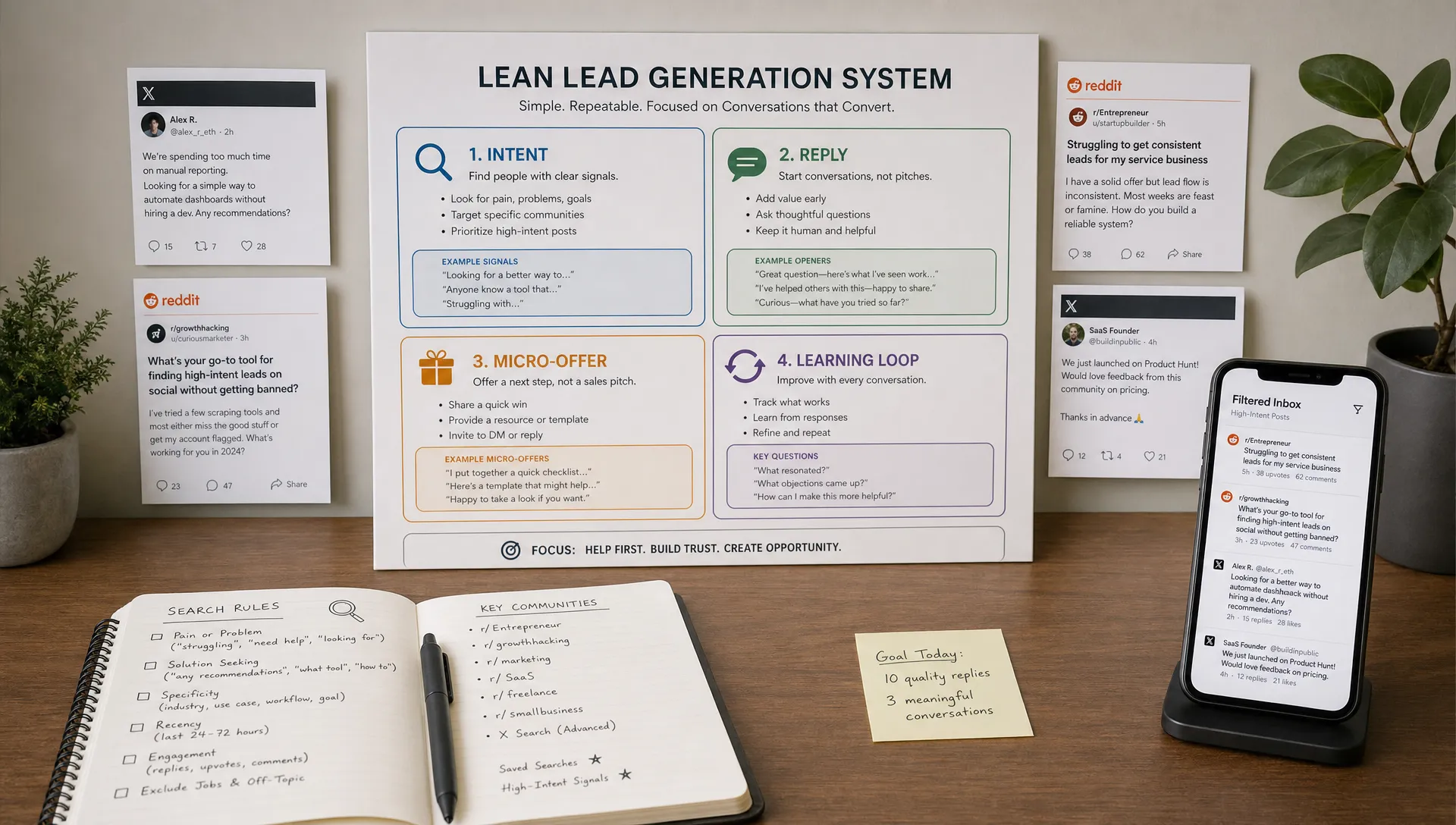
Why lean teams need different digital marketing playbooks
Lead generation digital marketing is often presented as a budget problem: spend more on ads, buy more tools, publish more content, hire more reps. Lean teams know the real constraint is usually attention. You have limited hours, limited audience, and limited room for experiments that take months to pay back.
The advantage of a lean team is speed. You can spot a buying signal, reply like a human, learn from the interaction, and update your messaging before a larger team has finished its campaign brief. The playbooks that work best are not the ones that maximize activity. They are the ones that reduce the distance between buyer intent and a useful response.
This guide focuses on practical playbooks for founders, solo marketers, small growth teams, and sales-led startups that need pipeline without bloated spend. The common thread is simple: listen first, engage with context, and turn every conversation into a compounding asset.
The lean-team lead generation operating system
Before choosing channels, define the operating system. A lot of teams jump straight into tactics, then wonder why they are generating noise instead of pipeline. Lean lead generation only works when everyone agrees on who matters, what counts as intent, how to respond, and how learning gets captured.
| Layer | Question to answer | Lean-team output |
|---|---|---|
| Ideal customer profile | Who has the painful problem we solve now? | A narrow segment with clear exclusion rules |
| Intent sources | Where do those people ask for help or compare options? | A short list of public channels, communities, and search patterns |
| Response motion | What is the fastest helpful next step? | A repeatable reply, follow-up, or micro-offer |
| Learning loop | What did the market teach us this week? | Updated search rules, landing page copy, FAQs, and sales notes |
The goal is not to build a giant marketing machine. It is to create a small system that runs every day. For many lean teams, that means treating public conversations as the first touchpoint in the buying journey, not just social media activity. Pounce has written more about why inbound lead generation starts in public conversations, and that idea is the foundation for several of the playbooks below.
Playbook 1: Listen for intent before creating more content
The default marketing instinct is to publish. But if your team is lean, the better first move is often to listen. Public posts on X, Reddit, and niche communities reveal what people are trying to solve, which alternatives they are considering, what language they use, and what objections keep coming up.
High-intent conversations often include phrases like:
- Looking for a tool that can help with...
- Any alternatives to [competitor]?
- How are people handling [pain point]?
- Is [category] worth it for a small team?
- We tried [solution], but it failed because...
- What do you use for [workflow]?
These are not vanity impressions. They are market signals. A person asking this kind of question is already problem-aware, and sometimes already solution-aware. Your job is to reply with enough specificity that they feel understood.
A simple scoring system keeps the team focused:
| Signal | Intent level | Best response |
|---|---|---|
| Asking for tool recommendations | High | Give a short framework and mention your product only if relevant |
| Complaining about an existing workflow | Medium to high | Diagnose the likely cause and offer a practical fix |
| Sharing a general opinion | Low | Add insight, but do not treat it as a lead |
| Comparing vendors | High | Explain tradeoffs honestly and invite a deeper conversation |
| Asking beginner education questions | Medium | Teach first, then point to a lightweight resource |
Pounce can help lean teams monitor X and Reddit in real time, filter for relevance with AI, and collect posts into an inbox so you are not manually refreshing feeds. If X and Reddit are core to your market, the more detailed lead generation strategy for X and Reddit is a useful next layer.
Playbook 2: Use a reply-first distribution model
Original content is useful, but it can be slow for small accounts. A reply-first model flips the order. Instead of waiting for your own posts to earn attention, you join conversations that already have the right audience.
This works especially well on X, where the right reply under the right post can outperform a standalone post from a small account. The key is to avoid generic agreement. A strong reply adds a useful distinction, a quick example, or a practical next step.
A reliable reply structure looks like this:
- Name the situation clearly.
- Explain the hidden cause or tradeoff.
- Share a practical recommendation.
- Offer a next step only if it fits the thread.
For example, instead of replying with a pitch like, We built a tool for this, try reframing the problem first: If you are only tracking keywords, you will catch too many low-intent mentions. Try separating pain keywords from buying phrases like alternatives, recommendations, and how do I choose. That gives the reader value whether or not they click through.
If X is a priority channel, Pounce’s guide to the reply-first strategy for growing on X goes deeper on how smaller accounts can borrow attention without sounding opportunistic.
Playbook 3: Turn repeated questions into conversion assets
Intent listening does more than generate replies. It gives you customer language. When the same question appears repeatedly, it should become a landing page section, comparison page, blog post, sales enablement note, or onboarding email.
Lean teams often struggle because their website copy reflects how they describe the product, not how buyers describe the pain. Public conversations fix that. If ten prospects describe the problem as wasting mornings finding relevant threads, that phrase belongs closer to your headline than an internal category label.
| Repeated market signal | Asset to create |
|---|---|
| People ask how to choose between tools | Comparison guide or decision checklist |
| People misunderstand the category | Educational blog post or short explainer |
| People worry about setup time | Landing page section showing the first workflow |
| People ask about team fit | Use-case page for that role or company size |
| People repeat the same objection | FAQ answer, sales note, or proof point |
This is where lead generation digital marketing becomes compounding. A single conversation may produce one reply today, but the pattern behind it can improve conversion for months.
Playbook 4: Create micro-offers for buyers who are not ready to book a demo
A common mistake is moving too quickly from public conversation to sales ask. Someone who posts a question may be interested, but that does not mean they are ready to book a demo with a stranger.
Micro-offers bridge that gap. They are small, helpful next steps that reduce friction and earn trust. For a lean team, the best micro-offers are easy to deliver and closely tied to the problem you solve.
Good micro-offers include a quick teardown, a checklist, a short benchmark, a curated example set, a template, or a lightweight audit. The point is not to hide the product. The point is to match the ask to the buyer’s current level of commitment.
For example, if someone asks how to find better Reddit leads, a helpful response might end with: If useful, I can share the three search rules I would test first for your category. That is more natural than asking for a sales call immediately.

Playbook 5: Partner where trust already exists
Partnerships are underrated for lean teams because they let you borrow trust, not just attention. You do not need a massive partner program to start. You need a small number of people, communities, or brands that already reach your ideal customer.
Practical partnership plays include newsletter swaps, community office hours, guest workshops, co-authored guides, integration content, and creator collaborations. The best version is specific: one pain point, one audience, one useful outcome.
For example, a founder selling to YouTube creators might partner with a sponsorship expert to teach creators how to pitch brands. Creator-led companies can also research sponsorship fit with GetSponsored, a directory for finding brands that sponsor YouTube channels, which is useful when a channel is part of the demand engine.
The lean-team rule is to avoid vague co-marketing. Do not partner because audiences are generally similar. Partner because you can name the exact problem your shared audience wants solved.
Playbook 6: Retarget the question, not just the person
Retargeting is usually discussed in ad terms, but lean teams can apply the same idea organically. When someone asks a strong question in public, assume others have the same question silently. Turn that question into reusable content.
A Reddit thread can become a founder post. A sales objection can become a FAQ. A comparison question can become a landing page module. A frustrated X post can become a short diagnostic checklist.
The workflow is simple: capture the question, identify the underlying pain, write the clearest answer, and distribute it across one or two channels. Over time, your content library starts to mirror real buyer demand instead of internal brainstorming sessions.
This also improves sales conversations. When a prospect raises a familiar concern, your team can answer with language that has already been tested in public.
Playbook 7: Run a 15-minute daily pipeline sprint
Consistency beats intensity. A lean team does not need to spend all day on social lead generation, but it does need a daily habit. A focused 15-minute sprint can be enough to find relevant conversations, reply while the thread is still active, and capture what you learned.
| Time | Action | Outcome |
|---|---|---|
| Minutes 0 to 2 | Review relevant posts in your inbox | Start with filtered opportunities, not an open feed |
| Minutes 2 to 6 | Qualify by pain, timing, and fit | Ignore threads that are noisy or off-market |
| Minutes 6 to 12 | Draft and personalize replies | Ship helpful responses while the conversation is fresh |
| Minutes 12 to 15 | Log patterns and adjust rules | Improve tomorrow’s lead quality |
This is where a tool like Pounce fits naturally. Its real-time X and Reddit monitoring, AI-powered filtering, AI-assisted reply drafting, customizable search rules, daily reply goals, session stats tracking, and automatic filter improvement are designed around short, focused engagement sessions.
If your team wants a more detailed morning routine, the guide on finding accounts worth replying to every morning pairs well with this sprint.
Metrics that matter when every hour counts
Lean teams need metrics that reveal learning and pipeline quality, not just activity. A dashboard full of impressions can make the team feel busy while hiding the fact that no one is closer to buying.
Track the numbers that connect effort to intent:
| Metric | What it tells you | How to interpret it |
|---|---|---|
| Relevant conversations found | Whether your search rules are working | Low volume may mean rules are too narrow or the channel is wrong |
| Qualified replies sent | Whether the team is acting on intent | High volume with low response may mean replies are too generic |
| Reply-to-response rate | Whether your message earns engagement | Strong replies usually feel diagnostic, not promotional |
| Conversations moved private | Whether trust is building | A useful sign, but only if the fit is real |
| Micro-offer acceptance | Whether your next step matches buyer readiness | Low acceptance may mean the offer is too heavy or too vague |
| Sales-qualified opportunities | Whether the system creates pipeline | Review the original signal to refine future targeting |
The key is to review metrics weekly, not obsess over every reply. Public conversation lead generation has variance. Some days are quiet. Some threads explode. The trend matters more than any single session.
Common mistakes lean teams should avoid
Treating every mention as a lead
A keyword match is not the same as intent. Someone mentioning your category may be educating themselves, venting, or speaking outside your ICP. Qualify before you reply, or your team will waste time in low-value threads.
Using AI to sound polished instead of useful
AI-assisted replies can save time, but overly polished responses often feel disconnected from the thread. The best replies are specific to the person’s situation. Use AI for speed, then edit for judgment.
Pitching before earning context
If your first interaction is a hard pitch, you make the conversation about you. Lead with the buyer’s problem. A product mention lands better after you have shown you understand the situation.
Running too many channels at once
Lean teams lose focus when they try to operate like large marketing departments. Start with one or two channels where intent is visible. Build the daily habit first, then expand.
Failing to update the system
If you learn something from replies but never update search rules, copy, or offers, the system does not compound. Treat every week as a feedback cycle.
A 30-day implementation plan
You do not need a quarter-long transformation to put these playbooks to work. A lean team can build the first version in 30 days.
| Week | Focus | Deliverable |
|---|---|---|
| Week 1 | Define ICP and intent rules | A short list of search rules, exclusion rules, and priority pain points |
| Week 2 | Start daily reply sprints | A consistent 15-minute workflow and first set of qualified replies |
| Week 3 | Build micro-offers | One or two lightweight next steps based on common questions |
| Week 4 | Turn learning into assets | Updated website copy, FAQs, content ideas, and improved rules |
By the end of the month, you should know which conversations are worth pursuing, which messages earn responses, and which objections need better assets. That is a stronger foundation than a pile of unqualified leads.
FAQ
What is lead generation digital marketing for lean teams?
It is the process of using digital channels to create qualified pipeline with limited time, budget, and headcount. For lean teams, the best approach usually prioritizes high-intent signals, fast response, practical follow-up, and continuous learning instead of broad campaigns.
How can a small team generate leads without a large ad budget?
Start by finding public conversations where buyers are already asking for help, comparing tools, or describing pain. Reply with useful context, offer a lightweight next step, and turn repeated questions into content and landing page improvements.
Are X and Reddit good channels for lead generation?
They can be, especially when your buyers ask questions, share frustrations, or compare tools there. The key is filtering for intent. Broad keyword monitoring creates noise, while specific search rules can surface conversations worth replying to.
How many replies should a lean team send each day?
Quality matters more than volume. A small team may get more value from five thoughtful replies to high-intent posts than from fifty generic responses. Set a daily reply goal, but review whether those replies create responses, conversations, and qualified opportunities.
Should AI write all of our lead generation replies?
AI is best used as an assistant, not an autopilot. Let it help draft, summarize, and speed up your workflow, then edit each reply so it matches the thread, the buyer’s context, and your point of view.
When should we move a public conversation into a private channel?
Move private when the person asks for details, shares a specific use case, accepts a micro-offer, or needs information that does not fit the public thread. If the conversation is still educational, keep adding value publicly.
Build a daily pipeline habit
The best lead generation digital marketing playbooks for lean teams are not complicated. Find the right conversations, respond while intent is fresh, offer a helpful next step, and feed the learning back into your messaging.
Pounce is built for that rhythm: real-time X and Reddit monitoring, AI-powered filtering, AI-assisted reply drafting, customizable rules, an inbox for relevant posts, daily reply goals, and focused 15-minute sessions. If your team wants more pipeline without living in feeds all day, start by making the right replies part of your daily operating system.