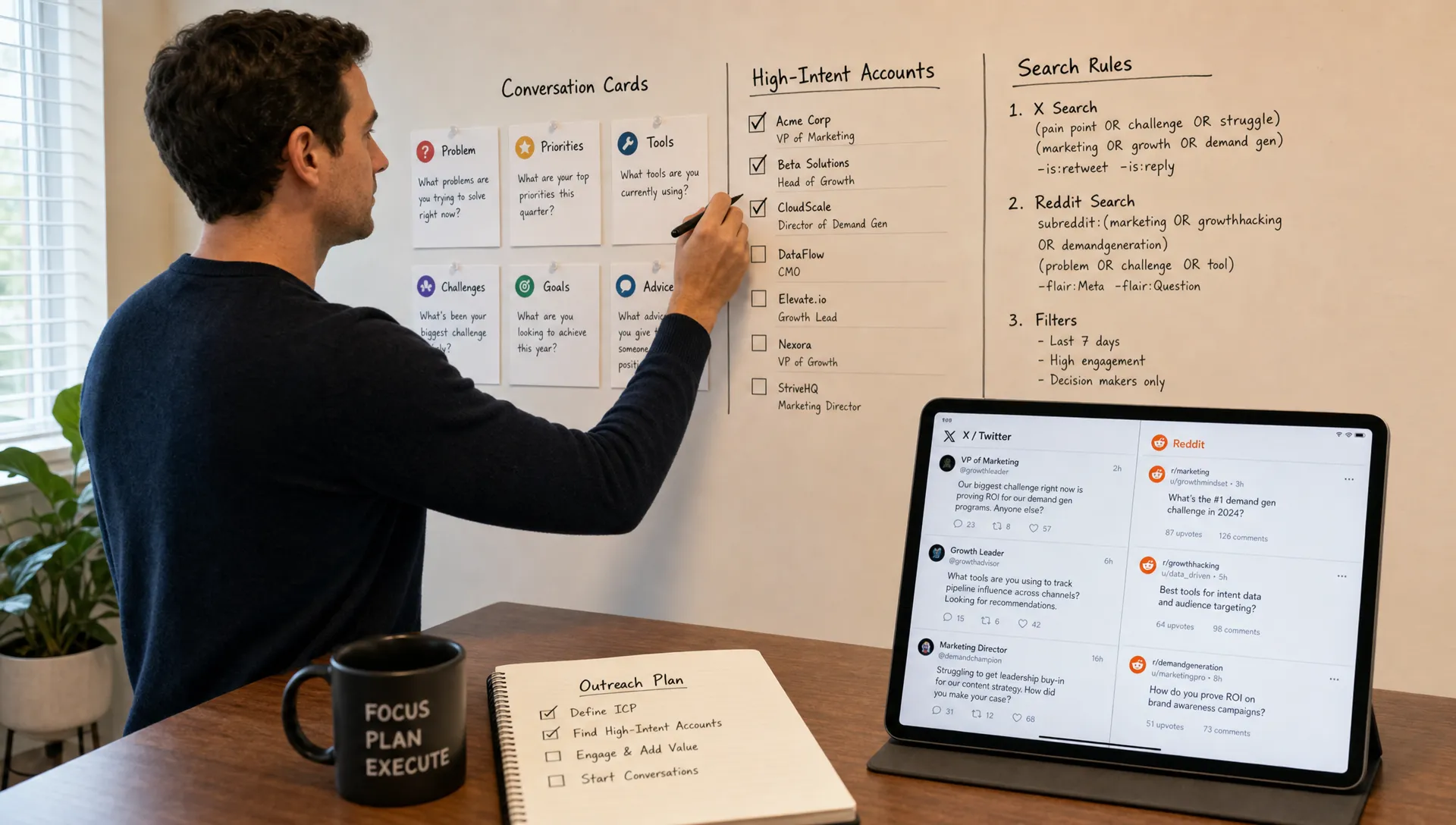
The goal: fewer accounts, better replies
Most founders, creators, and marketers do not have a replying problem. They have a filtering problem. Opening X or Reddit in the morning and hoping the algorithm hands you the right person is a recipe for random engagement, half-relevant threads, and replies that never compound.
A better approach is to find accounts that already show a reason to talk. That reason might be a public complaint, a question, a tool comparison, a hiring signal, a launch, a community discussion, or a repeated pattern in their recent posts. Your job is not to reply to everyone. Your job is to build a short daily queue of people and conversations where your experience can actually help.
For Pounce users, this fits naturally into a quick morning session: monitor the right X and Reddit conversations, review the best matches, reply while the thread is fresh, and improve the filters based on what was useful.
What makes an account worth replying to?
An account is worth replying to when there is a strong connection between who they are, what they are talking about, and what you can credibly add. Follower count is only one small signal. A 300-follower founder asking a specific buying question can be more valuable than a 200,000-follower creator posting a broad opinion.
Think of reply value in three layers. First, the account should be relevant to your audience or market. Second, the post should reveal intent, pain, curiosity, or a decision in progress. Third, the conversation should be active enough that your reply has a real chance of being seen.
This is why daily replying works best when it is not treated as a vanity growth tactic. It is closer to lightweight social listening. You are looking for moments where a public answer can start a private relationship, educate other lurkers, and put your name in front of people who already care about the problem.
A good account does not need to be ready to buy today. But it should be close enough to your world that a helpful reply creates future surface area. If you sell to early-stage SaaS founders, for example, a founder asking about onboarding, churn, or first customers is likely more relevant than a general startup meme account.
Start with search rules, not the feed
The fastest way to waste a morning is to let the feed decide your priorities. Feeds reward recency, controversy, and your past behavior. They do not reliably reward business relevance. To find accounts worth replying to every morning, start with rules that describe what a good conversation looks like.
Good search rules usually combine several types of language:
- Pain language: phrases people use when they are frustrated, blocked, confused, or looking for a better way.
- Buying language: terms like alternative, recommendation, tool, agency, consultant, pricing, stack, and best way.
- Comparison language: mentions of competitors, category names, or workflows people are trying to replace.
- Community context: subreddit names, role names, job titles, niche phrases, and industry shorthand.
- Exclusions: words that attract irrelevant posts, jobs, giveaways, memes, or academic discussions.
The best rules sound like your customers, not your positioning deck. If your site says customer intelligence platform but your buyers say where do you find user interviews, your monitoring should include the second phrase.
Tools like Pounce are useful here because they can monitor X and Reddit in real time, apply AI-powered filtering, and collect relevant posts in an inbox instead of forcing you to scroll from scratch. The human work is deciding which accounts deserve a thoughtful reply.
Score the account before you reply
A morning reply habit becomes much easier when you stop debating every post from zero. Use a simple scorecard. It should be fast enough to apply in a few seconds, but structured enough to keep you from chasing shiny threads.
| Signal | 0 points | 1 point | 2 points |
|---|---|---|---|
| Audience fit | Not your market | Adjacent to your market | Clear ICP or strong influencer of your ICP |
| Intent | Generic post or entertainment | Mild curiosity or indirect pain | Specific question, complaint, comparison, or request |
| Recency | Old or inactive thread | Recent but slowing down | Fresh and actively receiving replies |
| Conversation quality | Low-signal replies or arguments | Some useful discussion | People are asking follow-up questions |
| Relationship potential | No obvious next step | Possible follow-up later | Clear opening for helpful advice or future conversation |
A post that scores 8 to 10 should usually get a thoughtful reply now. A post in the 5 to 7 range may be worth saving, especially if the account is a strong fit. Anything below that is probably a skip, even if the account is big.
This scorecard also protects your tone. When an account is high intent, you can be more specific and useful. When it is low intent, a reply often becomes performative, and people can feel that you are trying to force relevance.
The 15-minute morning workflow
A practical daily system does not need an hour. In fact, shorter is often better because it forces prioritization. The goal is to start the day with a focused batch of high-intent conversations, not an open-ended scroll.
Use this 15-minute workflow:
- Minutes 0 to 3, open your inbox or saved search results: Do not start with the main feed. Review posts that already match your rules across X and Reddit.
- Minutes 3 to 6, score the top conversations: Quickly identify account fit, intent, recency, and whether your reply can add something specific.
- Minutes 6 to 12, reply to the best accounts first: Prioritize the accounts where your expertise can be useful without a hard pitch.
- Minutes 12 to 15, improve the system: Mark false positives, save strong phrases, adjust search rules, and note which replies deserve follow-up.
If you are using Pounce, features like daily reply goals, session stats tracking, customizable search rules, and automatic filter improvement can help make this habit repeatable. You still bring the judgment. The tool reduces the time spent digging.
This routine pairs especially well with a reply-led growth motion. If X is your main channel, Pounce's guide to the reply-first strategy for growing on X explains why thoughtful replies often outperform posting into the void, especially for smaller accounts.

How to evaluate accounts on X
On X, account-level signals matter a lot. You can quickly check whether the person posts often, whether they reply to others, what topics they consistently discuss, and whether their audience overlaps with yours.
Do not over-index on follower count. A large account may create reach, but a relevant account creates leverage. The strongest X accounts to reply to often have a combination of niche relevance, active replies, and repeated discussion of the problem you solve.
Look for accounts that show at least one of these patterns: they ask specific operational questions, they compare tools, they complain about a recurring workflow, they share lessons from building in your category, or their replies are full of people asking for recommendations. Those signals tell you the conversation is not just visible, it is useful.
Also check whether the account engages back. Some accounts broadcast but never respond. Others treat replies as a real discussion layer. The second group is usually more valuable for relationship-building, even if the audience is smaller.
How to evaluate accounts on Reddit
Reddit is different because the account is often less important than the thread, subreddit, and problem context. Many users are anonymous or semi-anonymous, so you are not always evaluating personal brand. You are evaluating intent.
A Reddit account is worth replying to when the post is specific, the subreddit is relevant, and the user seems open to advice. For example, a vague complaint in a broad subreddit is usually weaker than a detailed workflow question in a specialized community. The second gives you room to be useful without sounding promotional.
Before replying, check the subreddit norms. Some communities welcome tool recommendations if they are disclosed and genuinely helpful. Others punish anything that feels like marketing. Read the top comments, match the level of detail, and avoid turning a community answer into a sales pitch.
When a thread has strong buying or problem intent, your reply should give value even if the user never clicks your profile. If you want a deeper playbook for this channel, see Pounce's guide on how to turn a Reddit post into qualified leads without sounding spammy.
Write replies that make the account worth finding
Finding the right accounts is only half the habit. The reply itself determines whether the moment turns into a relationship.
A strong reply usually has four parts: acknowledge the specific context, add a useful observation, offer one next step, and leave a low-friction opening for discussion. You do not need to be long. You do need to be specific.
For example, instead of saying, Great point, you should try better onboarding, you might say: If users understand the value but disappear before setup, I would separate activation from education. Get them to one completed action first, then teach the advanced workflow later. Are you seeing drop-off before or after the first successful use?
That reply works because it shows you read the post, contributes a concrete idea, and asks a relevant follow-up. It does not demand a demo, a call, or a click.
AI-assisted reply drafting can speed up the first version, especially when you are replying every morning. But the final reply should sound like someone who actually understands the thread. Resources around AI detection and writing tools can help you notice patterns that make AI-written text feel generic, repetitive, or overly polished before your prospects notice them.
Keep a simple reply database
The accounts you find each morning should not vanish after the reply. Even a lightweight database can show which conversations are worth more of your time.
You do not need a complex CRM at first. A simple sheet, note, or built-in session history can be enough. Track the account, channel, topic, why it matched, whether you replied, and what happened next. Over time, this reveals which rules create real conversations and which only create noise.
| Field | Why it matters |
|---|---|
| Account or thread | Lets you revisit strong conversations later |
| Channel | Helps compare X and Reddit performance |
| Trigger phrase | Shows which language indicates intent |
| Fit score | Keeps you honest about relevance |
| Reply status | Prevents duplicate or forgotten outreach |
| Outcome | Separates likes from conversations and leads |
This is where the morning habit starts to compound. You are no longer simply replying. You are learning which account types, problems, and communities are most responsive. That learning improves your search rules, your positioning, and your future content ideas.
Common mistakes that make reply lists worse
The most common mistake is chasing famous accounts instead of relevant ones. Big accounts can help with visibility, but they are often crowded, broad, and hard to convert into real conversations. Mix in smaller, high-fit accounts where your reply has a better chance of being noticed.
Another mistake is replying too late. If a high-intent post is already a day old and the conversation has moved on, your reply may still be useful, but it is less likely to spark a response. This is why real-time monitoring matters. Timing is part of relevance.
A third mistake is treating every account as a lead. Some accounts are better for distribution, some for research, some for partnerships, and some for direct sales. If you only value immediate conversion, you will miss conversations that build authority and trust over time.
Finally, do not ignore false positives. If your search rules keep surfacing irrelevant posts, fix the rule. Add exclusions, tighten phrases, or adjust the communities you monitor. A better morning list is built through small improvements, not one perfect setup.
FAQ
How many accounts should I reply to every morning?
Start with 5 to 15 high-quality replies. The exact number matters less than consistency and relevance. If you only have time for five, make them specific, timely, and genuinely useful.
What is the fastest way to find accounts worth replying to?
The fastest way is to monitor intent-based phrases on X and Reddit, filter for audience fit, then score each conversation by relevance, intent, recency, and relationship potential. Avoid starting from the main feed.
Should I prioritize big accounts or smaller relevant accounts?
Prioritize relevance first. Big accounts can create reach, but smaller accounts often respond more often and can be closer to the problem you solve. A balanced morning list includes both.
Is replying on Reddit different from replying on X?
Yes. On X, the account's audience and posting history matter more. On Reddit, the thread, subreddit norms, and problem specificity often matter more than the user's profile.
Can AI help me write replies?
Yes, AI can help draft replies faster, but you should always edit for context, specificity, and tone. The goal is not to sound polished. The goal is to sound useful and human.
Make your morning replies compound
Finding accounts worth replying to every morning is not about squeezing more activity into your day. It is about replacing random scrolling with a repeatable system: define the right signals, monitor the right conversations, score quickly, reply with context, and improve your filters over time.
Pounce was built for that workflow. It monitors X and Reddit in real time, filters for relevant posts, helps draft replies, tracks session stats, and keeps your morning engagement focused on conversations that are actually worth your attention.
If you want your next 15 minutes to produce better replies instead of more tabs, start by tightening the accounts you choose to engage with. The quality of your reply list sets the quality of your relationships.