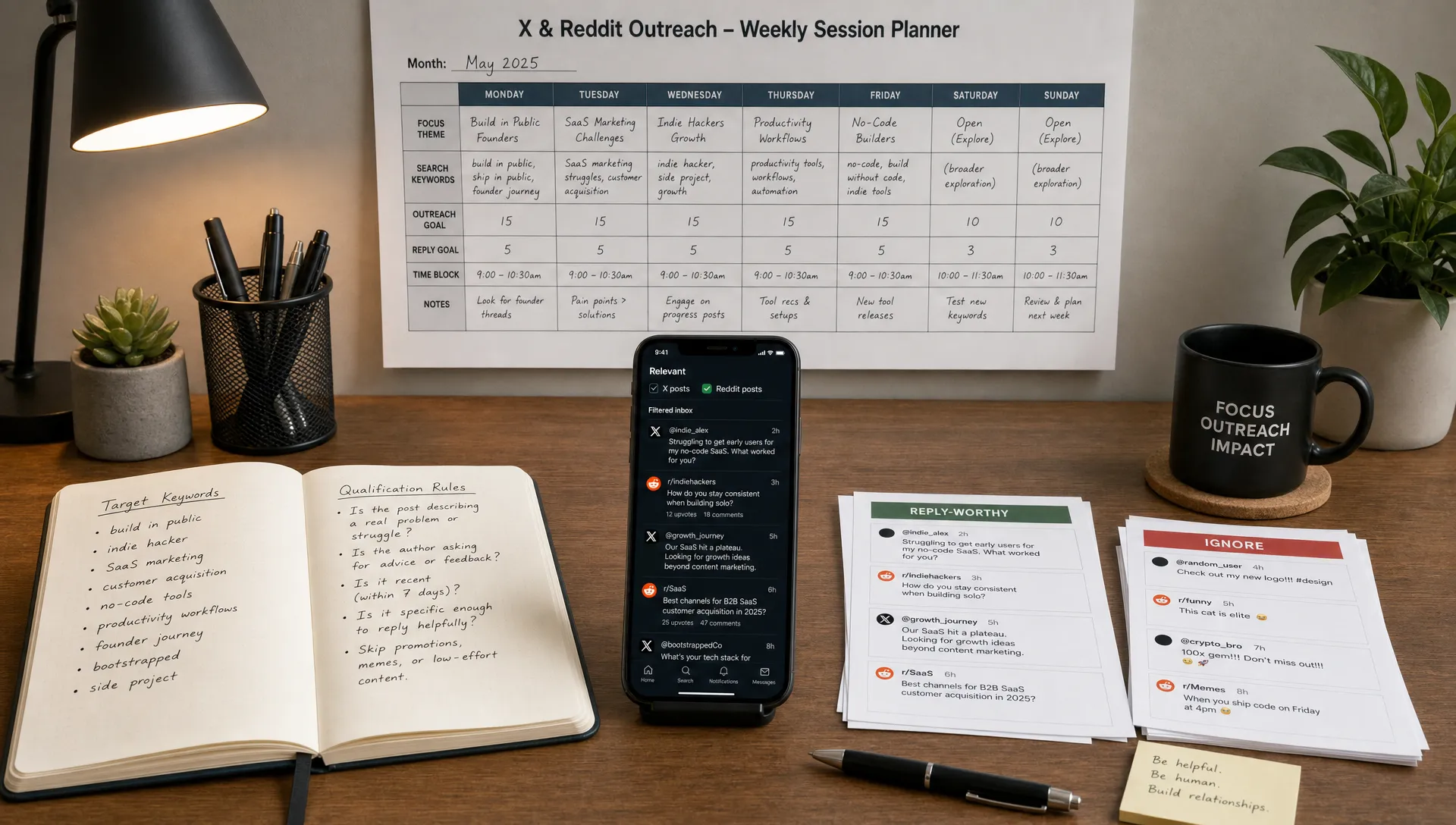
The opportunity: sell timing, not databases
Starting a lead generation business used to mean buying contact lists, enriching emails, blasting sequences, and hoping the targeting was close enough. That model still exists, but it is getting harder to defend. Buyers ignore generic outreach, inboxes are crowded, and many teams have already been burned by agencies that promise leads but deliver names.
A more durable model is built around social intent. Instead of guessing who might need a product someday, you monitor public conversations where people are already asking for help, comparing tools, complaining about a workflow, or looking for recommendations. Your service helps clients show up at the right moment with a useful reply.
That difference matters. A social intent lead generation business does not sell a spreadsheet. It sells context, timing, and qualified conversations.
What a social intent lead generation business actually sells
A lead generation business based on social intent finds active demand signals on platforms like X and Reddit, qualifies them, and helps clients engage without sounding like a bot. The output is not just “15 leads per week.” The output is a repeatable system for getting in front of relevant buyers while they are already thinking about the problem.
At its simplest, your service has four jobs:
- Find public conversations that match a client’s ideal customer profile.
- Filter out noise so the client only sees posts worth replying to.
- Draft or recommend helpful replies that fit the conversation.
- Track which signals, messages, and communities convert into pipeline.
This is different from traditional social listening. Social listening often measures brand mentions, sentiment, or competitor chatter. Social intent monitoring is more direct. It looks for buying signals, pain signals, switching signals, and recommendation requests.
For example, “What is the best CRM for a small agency?” is not just a topic. It is a potential sales moment for a CRM, CRM consultant, implementation partner, or sales ops tool. “Has anyone replaced Intercom with something lighter?” could be an opportunity for a support tool. “I’m drowning in manual reporting” might be a fit for an analytics consultant or automation product.
The business opportunity is in turning those scattered signals into a client-ready workflow.
Choose a niche before you choose a tool
The biggest mistake new operators make is trying to serve everyone. “We find leads on Reddit and X” is not a strong offer by itself. A cybersecurity company, a no-code agency, a devtool startup, and a B2B coach all need different signals, communities, terminology, and response styles.
Start with a narrow market where conversations are frequent and problems are easy to recognize. You want a niche where people talk publicly before they buy. Some categories are naturally strong for this: SaaS, agencies, developer tools, productivity products, marketing services, design tools, recruiting, finance ops, and founder services.
Use this table to pressure-test your niche:
| Niche decision | What to define | Good sign | Warning sign |
|---|---|---|---|
| Client type | Who pays you | They already spend on growth or outbound | They do not know their ICP yet |
| Buyer profile | Who your client wants to reach | Buyers ask questions in public communities | Buyers only buy through private procurement |
| Problem language | How buyers describe pain | You can list 20 phrases they actually use | You rely on industry jargon only |
| Response path | What happens after a reply | A helpful comment can start a DM, demo, or call | Any outreach feels intrusive |
| Proof potential | How fast you can show value | You can find relevant posts in a few days | You need months to see signal volume |
If you plan to serve SaaS clients, this guide on SaaS lead generation strategies for small teams is a useful companion because it emphasizes narrow ICPs, buying signals, lean outbound, and pipeline-focused metrics.
Build a social intent map
Once you choose a niche, your next asset is an intent map. This is a structured list of signals that suggest someone might be open to help. It should include keywords, phrases, communities, competitors, pain points, and disqualifiers.
Do not start with broad keywords like “marketing,” “sales,” or “software.” Broad terms create noise. Start with phrases people use when they are actively searching, frustrated, comparing, or implementing.
| Intent signal | Example phrase pattern | What it usually means | Best reply angle |
|---|---|---|---|
| Recommendation request | “Best tool for...” or “Any alternatives to...” | The buyer is actively exploring options | Share criteria, tradeoffs, and a relevant suggestion |
| Competitor frustration | “I’m tired of...” or “Why is [tool] so expensive?” | The buyer may be considering a switch | Acknowledge the pain and explain what to evaluate next |
| Workflow pain | “How do you handle...” or “Is there an easier way to...” | The buyer has a problem but may not know the category | Offer a practical process before mentioning a solution |
| Implementation blocker | “Can’t get [tool] to work with...” | The buyer is stuck and needs expertise | Give a specific troubleshooting step or resource |
| Budget or urgency clue | “Need this by next week” or “for a small team” | The buyer has constraints and urgency | Match the response to speed, simplicity, and fit |
| Negative fit | “Free only” or “student project” | Low commercial value | Skip or reply only if strategically useful |
Your intent map should improve every week. When a client says a post was not relevant, capture why. When a post turns into a meeting, capture the wording that made it valuable. Over time, your system becomes more accurate because it learns from real market feedback.
This is where tools matter. You can start manually, but a serious lead generation business needs a reliable way to monitor X and Reddit in real time, filter for relevance, and avoid missing the posts that matter.
Validate the offer with a small pilot
Before selling a long retainer, run a focused pilot. A pilot proves three things: there is enough public intent in the niche, your qualification criteria are accurate, and the client can turn conversations into pipeline.
A strong pilot is short, specific, and measurable. Instead of promising vague growth, promise a defined workflow: monitor selected topics, deliver qualified posts, include short context, and suggest replies. The point is not to close deals immediately. The point is to prove that public conversations can become a dependable acquisition channel.
| Pilot element | What to include | Why it matters |
|---|---|---|
| Duration | 7 to 14 days | Long enough to see signal, short enough to reduce risk |
| Platforms | X, Reddit, or both | Keeps the scope clear |
| Qualification rules | ICP, pain, urgency, relevance, disqualifiers | Prevents “lead” from meaning different things |
| Deliverables | Relevant posts, intent notes, reply drafts, weekly summary | Makes the value tangible |
| Success criteria | Positive replies, booked calls, saved research, content ideas | Measures more than raw volume |
If you want a broader view of this acquisition style, Pounce has covered how teams can do marketing lead generation without ads or cold DMs by listening for public buying intent and replying with useful context.
Design the delivery workflow
A social intent service becomes profitable when the workflow is simple enough to repeat. You need a way to monitor, qualify, respond, and learn without spending all day scrolling.
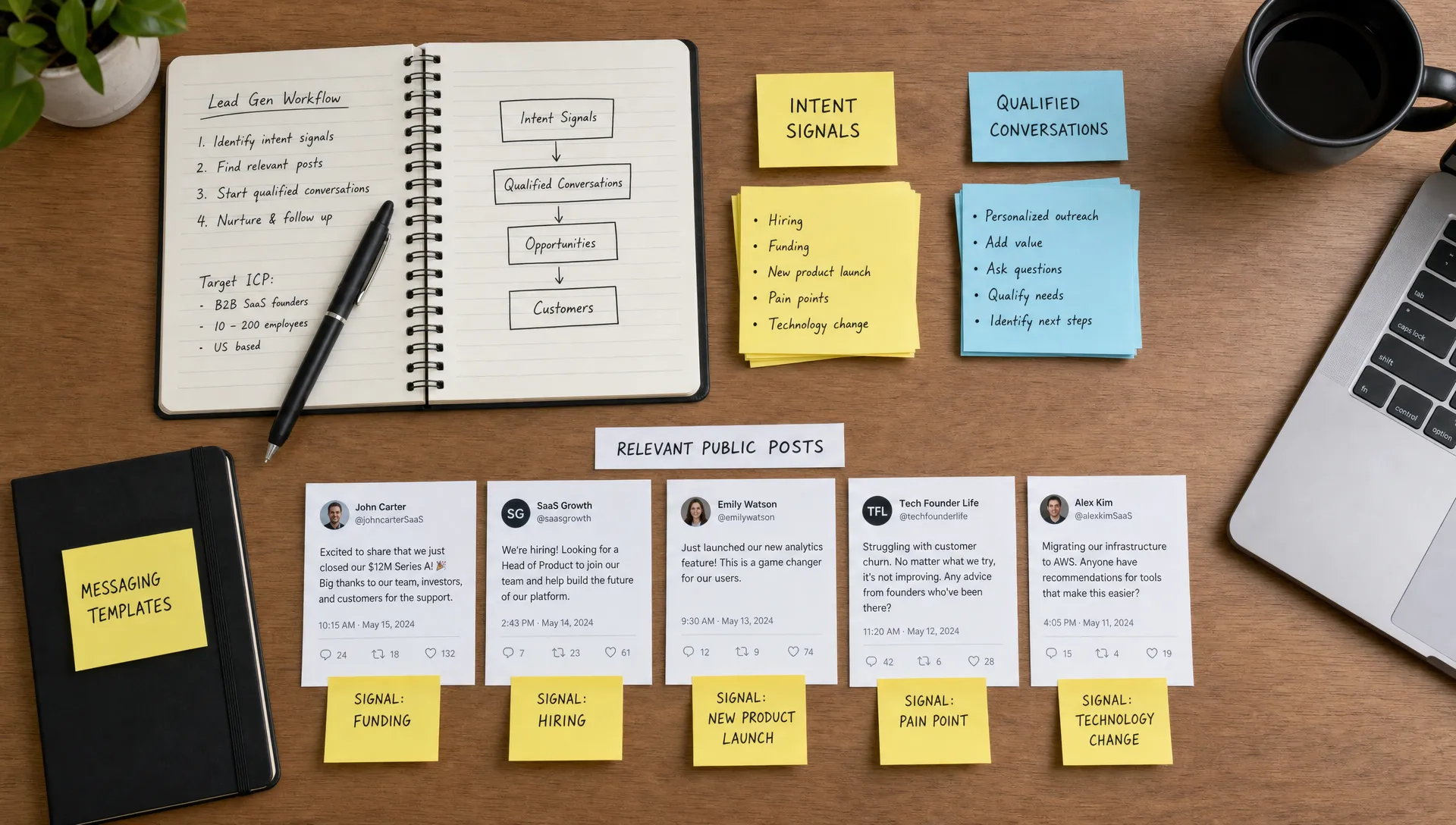
A practical workflow looks like this:
| Step | Operator action | Client value |
|---|---|---|
| Monitor | Track target keywords, competitors, communities, and phrases | Finds demand before competitors notice it |
| Filter | Remove jokes, irrelevant mentions, low-fit posts, and old threads | Saves the client time |
| Qualify | Score posts based on ICP fit, urgency, pain, and reply opportunity | Separates signal from noise |
| Draft | Write a helpful reply that fits the platform and context | Makes engagement faster and less awkward |
| Route | Send the post to the client or reply on an agreed process | Creates consistent execution |
| Review | Track outcomes and update rules | Improves future lead quality |
This is also where AI can give you leverage. For a solo operator or lean team, Pounce can monitor X and Reddit, surface relevant conversations in an inbox, help with AI-assisted reply drafts, support customizable search rules, and make short daily reply sessions easier to maintain. That does not replace your judgment. It compresses the manual work so you can focus on fit, messaging, and client outcomes.
Package the service around outcomes, not activity
Your clients do not want to pay for “monitoring.” They want more of the right people discovering them, replying to them, and entering their pipeline. Package your offer around that outcome.
A productized service is easier to sell than a custom consulting engagement. You can still tailor the keywords and ICP, but the delivery model should be clear.
| Offer type | Best for | Core deliverable | Risk to manage |
|---|---|---|---|
| Intent discovery audit | New clients testing the channel | Signal map, sample posts, opportunity analysis | Too much research, not enough action |
| Managed monitoring | Clients with a clear ICP | Curated conversations and reply suggestions | Volume expectations must be realistic |
| Reply enablement | Founders or sales teams who want to respond themselves | Drafts, context, and response guidelines | Client must act quickly |
| Full engagement support | Clients who trust your voice and process | Monitoring plus approved replies or handoffs | Requires clear brand and compliance rules |
| Insight report add-on | Teams that want market intelligence | Patterns, objections, competitor mentions, content ideas | Reports should not replace pipeline work |
Be careful with performance-only pricing at the beginning. It sounds attractive, but attribution can get messy. A prospect may see a Reddit reply, visit the website later, ask a teammate, and book through another channel. Early on, a fixed pilot or retainer with clear activity and quality criteria is usually easier to manage.
As you gain proof, you can add performance components tied to agreed outcomes, such as qualified meetings or accepted opportunities. But your foundation should be a clear promise: we find relevant buying conversations and help you engage while the timing is fresh.
Learn to write replies that feel native
The reply is where most lead generation businesses either build trust or destroy it. A bad reply turns public intent into spam. A good reply respects the conversation, adds useful context, and only introduces the client when it is relevant.
A helpful social intent reply usually has four parts:
- Recognize the specific problem in the post.
- Add one useful idea, tradeoff, example, or question.
- Mention a product or service only if it naturally fits.
- Leave room for the person to continue the conversation.
For example, if someone on Reddit asks for a lightweight project management tool for a five-person agency, the weak reply is “Use our tool, it’s the best.” The stronger reply is: “For a five-person agency, I’d look at how you handle client visibility first. Some tools are great internally but get messy when clients need updates. If you want lightweight, prioritize templates, permissions, and recurring tasks over advanced reporting.”
That kind of response can still create demand. It just earns attention before asking for it.
Reddit especially rewards specificity and punishes obvious promotion. If that platform is part of your offer, study how to turn a Reddit post into qualified leads without breaking the trust of the thread.
Get your first clients using your own method
The simplest way to sell a social intent lead generation business is to use social intent for yourself. Look for founders, marketers, and consultants publicly saying they need more pipeline, are tired of cold outbound, or want to understand Reddit and X as acquisition channels.
Instead of pitching immediately, create a small proof asset. Find 5 to 10 relevant posts their company could have replied to. Add a short note explaining why each post matters, what the buyer intent is, and how you would respond. This turns your outreach from “hire me” into “here are missed opportunities I found for you.”
Your first client acquisition message can be simple:
“Noticed a few public conversations this week where your team could have been helpful, especially around [specific pain]. I put together a short sample with the posts, why they look relevant, and possible replies. Want me to send it over?”
That message works because it is specific. You are not claiming to be a generic growth expert. You are showing that you can see demand the prospect is missing.
This also positions you differently from many traditional providers. If a prospect is considering outsourcing, it may help to understand the tradeoffs between lead generation companies and doing it in-house with AI, especially around learning, control, and speed.
Track the metrics that prove quality
A social intent lead generation business should not report vanity metrics like “mentions found” or “keywords tracked” as the main proof of value. Clients care about whether the conversations are relevant and whether replies create commercial momentum.
Track a small set of metrics that connect activity to pipeline:
| Metric | What it tells you | How to improve it |
|---|---|---|
| Relevant conversations found | Whether the niche has enough signal | Refine keywords, communities, and competitor terms |
| Qualification rate | Whether your filters are accurate | Add disqualifiers and better ICP rules |
| Reply speed | Whether the client engages while the thread is active | Use daily sessions and alerts for high-intent posts |
| Response rate | Whether the reply earns engagement | Improve specificity and reduce promotional language |
| Positive response rate | Whether the conversation has commercial potential | Tighten fit and adjust the call to action |
| Meetings or opportunities | Whether social intent contributes to pipeline | Align handoff, follow-up, and CRM tracking |
| Learning captured | Whether the service improves over time | Review wins, misses, objections, and language patterns |
The metric that often gets overlooked is reply speed. A recommendation thread can move quickly. If your client waits three days, the best answers may already have earned attention. This is why a 15-minute daily reply habit can outperform occasional deep research sessions.
Avoid the common mistakes
The business model is simple, but execution requires discipline. Most failures come from overpromising, targeting too broadly, or treating social platforms like email inboxes.
| Mistake | Why it hurts | Better approach |
|---|---|---|
| Selling lead volume before proving signal | Creates pressure to include low-quality posts | Start with a pilot and quality criteria |
| Using only broad keywords | Produces too much noise | Build phrase-level intent rules |
| Ignoring platform culture | Makes replies feel intrusive | Match the norms of each community |
| Pitching too early | Reduces trust and gets ignored | Lead with useful context |
| Not tracking misses | Keeps filters from improving | Review rejected posts weekly |
| Serving too many niches | Makes delivery inconsistent | Specialize until your workflow is repeatable |
The strongest operators develop taste. They know which posts are worth a reply, which are better left alone, and which reveal a pattern that should become content, sales messaging, or product positioning.
A simple 30-day launch plan
You do not need a large team to start. You need a niche, a signal map, a repeatable workflow, and proof that your service creates conversations.
| Timeline | Focus | What to produce |
|---|---|---|
| Days 1 to 3 | Pick a niche | ICP, buyer pains, competitor list, target platforms |
| Days 4 to 7 | Build the intent map | Keywords, phrases, communities, disqualifiers, sample posts |
| Days 8 to 14 | Run manual validation | 20 to 50 relevant conversations and notes on quality |
| Days 15 to 21 | Create a pilot offer | Scope, deliverables, success criteria, reporting format |
| Days 22 to 26 | Prospect with proof | Personalized opportunity samples for target clients |
| Days 27 to 30 | Deliver the first pilot | Curated posts, reply drafts, weekly review, next-step proposal |
By the end of 30 days, you should know whether your niche has enough intent, whether clients understand the value, and whether your workflow can scale beyond manual effort.
FAQ
Is a lead generation business still worth starting in 2026?
Yes, but the old model of selling generic contact lists is much harder to defend. A lead generation business is more valuable when it helps clients find active buying signals, engage with context, and learn from real market conversations.
What is social intent in lead generation?
Social intent is a public signal that someone may need help, advice, a product, or a service. It can appear as a recommendation request, competitor complaint, implementation question, urgent problem, or comparison thread on platforms like X and Reddit.
Do I need to scrape emails to make this work?
No. This model is built around public conversations and helpful engagement, not scraping private contact data. You may still use a CRM or follow-up process, but the first value comes from identifying relevant discussions and responding appropriately.
Should I focus on X or Reddit first?
Choose the platform where your niche shows the clearest intent. X can be faster-moving and useful for founder, SaaS, creator, and tech conversations. Reddit can be stronger for detailed problem-solving, tool comparisons, and community recommendations.
How should I price a social intent lead generation service?
Start with a paid pilot or fixed-scope retainer before experimenting with performance pricing. Make sure the client understands what counts as a qualified conversation, who replies, how fast they need to act, and how outcomes will be tracked.
Can AI run the whole business for me?
AI can monitor conversations, filter noise, draft replies, and speed up daily execution. It should not replace human judgment. Your value comes from niche understanding, qualification quality, client strategy, and knowing when a reply will be welcome.
Start with one niche and one daily habit
The fastest path is not to build a massive agency on day one. Start with one niche, one intent map, and one daily reply workflow. Find the conversations your clients are missing, help them respond with useful context, and turn the learnings into a repeatable service.
If you want a faster way to operationalize the workflow, use Pounce to monitor X and Reddit, surface high-intent conversations, draft better replies, and keep your daily engagement sessions focused.