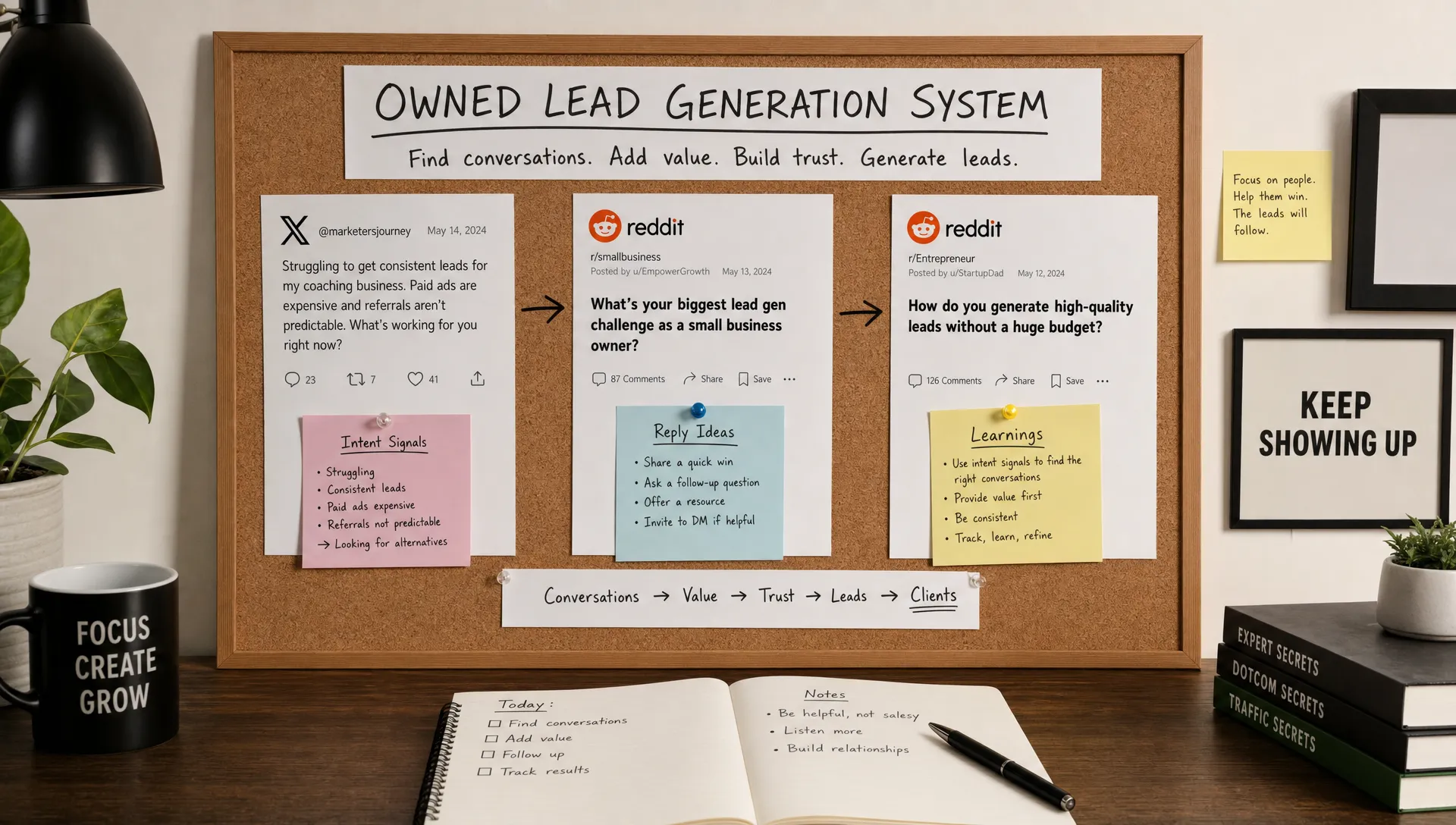
The decision has changed
For years, the default lead generation question was simple: should you hire a vendor or build an internal SDR motion? In 2026, that question is less obvious. AI can now monitor public conversations, filter for buying intent, draft context-aware replies, and help a small team engage consistently without hiring a full outbound department.
That does not make lead generation companies obsolete. It does mean the comparison needs to change. You are no longer choosing only between outsourced labor and internal headcount. You are choosing between renting execution from a third party and building an owned system that compounds as your team learns.
For SaaS founders, solo marketers, and lean revenue teams, the right answer depends on one thing above all: whether you already know exactly who to target, what message converts, and which channels create real conversations.
The core tradeoff: outsourced execution versus owned learning
Lead generation companies can be useful when you need capacity, structure, and outbound execution quickly. They may bring list-building processes, campaign management, appointment setting, reporting, and people who spend their day doing prospecting work.
Doing it in-house with AI offers a different value proposition. Instead of outsourcing the search for demand, you build a lightweight machine for finding and responding to demand yourself. The AI does not replace judgment. It helps your team notice more relevant conversations, prioritize better opportunities, and respond faster.
That distinction matters because early and growth-stage companies often need more than booked meetings. They need to understand buyer language, objections, use cases, competitor mentions, timing signals, and the questions prospects ask before they are ready to buy.
If you are already comparing vendors, it is worth reading a deeper breakdown of when a lead generation agency makes sense and when it does not. This article takes the next step: how that decision changes when AI gives your own team more leverage.
What lead generation companies usually provide
Not all lead generation companies do the same work. Some are outbound agencies. Some specialize in appointment setting. Others focus on data enrichment, cold email, LinkedIn outreach, paid acquisition, or full-funnel demand generation.
Most offers include some combination of prospect research, campaign setup, messaging, outreach, follow-up, reporting, and handoff to your sales team. In the best case, the company brings repeatable process and saves your team from building everything from scratch.
That works best when your fundamentals are already clear. A vendor can amplify a working message, but it usually cannot invent product-market fit for you. If your ICP is vague, your positioning is still shifting, or your offer only works after a nuanced founder conversation, outsourcing too early can create noise instead of pipeline.
The common failure mode is not that the vendor is lazy or incompetent. It is that they are forced to scale a message before the company has enough signal. The result is more outreach, more dashboards, and more meetings that look promising on paper but do not convert.
What doing it in-house with AI actually means
Doing lead generation in-house with AI does not mean letting a bot spam prospects. That is the fastest way to damage trust, especially on channels like X and Reddit where people can spot generic automation immediately.
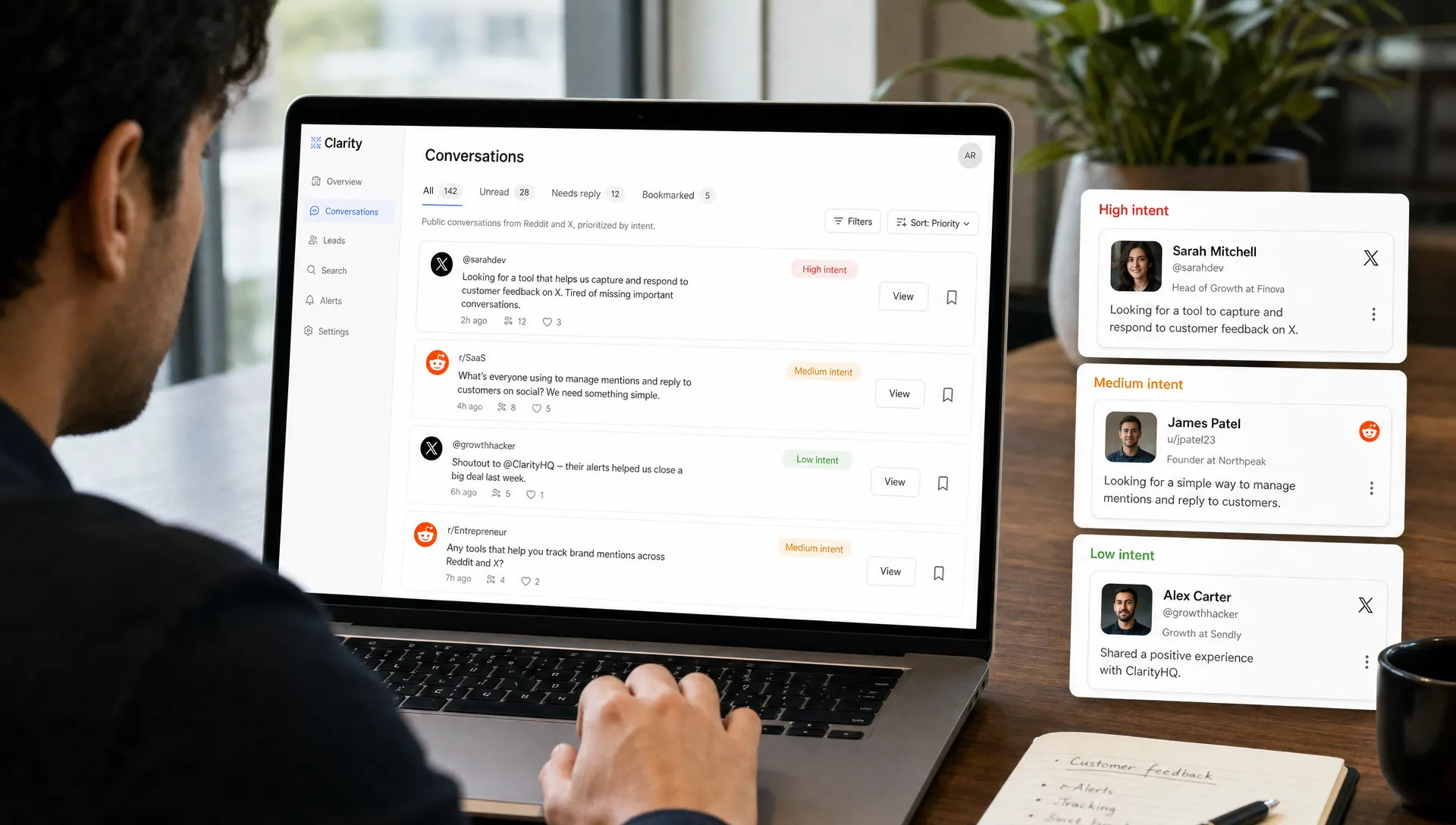
A better AI-assisted workflow looks like this: your team defines the conversations that matter, AI monitors for those signals, relevant posts land in an inbox, and a human decides whether and how to respond. AI can help draft replies, but the final answer should sound like someone who understands the problem.
For example, a small SaaS team might monitor X and Reddit for posts where people are asking for tool recommendations, complaining about a workflow, comparing competitors, or describing a pain point the product solves. Instead of sending cold DMs to a static list, the team joins conversations where demand is already visible.
That is why public conversation monitoring has become such a strong alternative to traditional outbound. Buyers often reveal problems before they fill out a demo form. They ask peers, complain in communities, compare options, and describe what they have already tried. If you can be useful in that moment, lead generation starts to feel less like interruption and more like timely help.
Pounce is built around this kind of workflow: real-time monitoring on X and Reddit, AI-powered filtering, AI-assisted reply drafting, customizable search rules, an inbox for relevant posts, session stats, daily reply goals, and quick 15-minute engagement sessions.
Side-by-side comparison
The right choice is easier when you compare the two options by what they actually optimize for.
| Decision factor | Lead generation companies | In-house with AI | What to watch |
|---|---|---|---|
| Speed to activity | Usually fast once onboarding is complete | Fast if your team can define search rules and reply daily | Activity is not the same as qualified demand |
| ICP learning | Often indirect, filtered through vendor reports | Direct, because your team sees raw buyer language | Early teams usually benefit from direct exposure |
| Message control | Shared with the vendor | Fully owned by your team | Brand voice matters on public channels |
| Channel fit | Strong if the company specializes in your channel | Strong when buyers talk publicly on X, Reddit, or communities | Some buyers are easier to reach by outbound than public replies |
| Cost structure | Retainer, campaign fee, pay-per-meeting, or similar model | Software plus internal time | Include management time in both options |
| Scalability | Can add capacity quickly | Scales through better rules, workflows, and team habits | Scaling bad messaging creates more bad outcomes |
| Data ownership | Depends on process and contract | Owned internally through your rules, notes, and learnings | Learning compounding is a major hidden advantage |
| Brand risk | Higher if outreach is generic or poorly targeted | Higher if AI replies are used without human review | Human judgment is non-negotiable |
The table shows why there is no universal winner. If your company has a proven outbound motion and needs more capacity, a lead generation company may be the practical choice. If your company is still learning where intent appears and what buyers care about, AI-assisted in-house work can be more valuable.
The hidden variable: intent quality
The biggest mistake in this comparison is treating every lead as equal. A contact who matches your firmographic criteria is not the same as a person actively asking for a solution. A booked meeting from a cold sequence is not the same as a reply from someone who just described the exact problem your product solves.
Lead generation companies often optimize around output: leads sourced, emails sent, meetings booked, show rates, or replies. Those metrics matter, but they can miss the quality of the original signal.
In-house AI workflows can optimize around live intent. That means looking for conversations where the prospect is already expressing pain, urgency, dissatisfaction, curiosity, or buying research. On X and Reddit, this might look like someone asking “What are people using for this?” or “Has anyone found a better way to solve this?” or “We are struggling with this workflow at work.”
That is the difference between chasing a list and joining a conversation. If you want to go deeper on this shift, Pounce has a related guide on why inbound lead generation starts in public conversations.
When lead generation companies are the better choice
Lead generation companies make the most sense when you already have a repeatable motion and need more hands to run it. For example, if you know your best-fit accounts, buyer titles, pain points, triggers, email angles, qualification criteria, and sales follow-up process, a specialized partner can help you increase volume.
They can also be helpful when your team has no bandwidth to manage daily prospecting. Even with AI, someone still has to review conversations, reply thoughtfully, track outcomes, and improve the system. If nobody internally can own that work, a vendor may be better than a tool that sits unused.
A lead generation company can also make sense for mature campaigns where the risk of lost learning is lower. If you are selling into a well-understood market, with clear segmentation and established proof, execution quality may matter more than raw customer discovery.
The key is to evaluate vendors based on fit, not promises. Ask how they define qualified leads, how they handle messaging, how much visibility you get into conversations, what happens when a meeting is low quality, and how feedback loops work.
When doing it in-house with AI wins
In-house AI tends to win when learning speed, message quality, and context matter more than brute-force volume. This is especially common for early-stage SaaS companies, technical products, founder-led sales motions, niche B2B categories, and products where buyers need education before conversion.
If your best conversations happen when someone asks a specific question, complains about a current tool, or describes a workflow problem, you probably want to be close to that signal. AI can help you find those moments without refreshing social feeds all day.
The in-house path is also stronger when brand trust matters. On Reddit, for example, communities punish shallow self-promotion. A helpful reply that explains tradeoffs and only mentions your product when relevant can start a relationship. A generic pitch can get ignored, downvoted, or removed.
This is why AI should be used as a filter and drafting assistant, not as an autopilot. The value comes from combining machine speed with human context. AI helps surface the post. Your team decides whether the person is a fit, what they actually need, and how to respond without sounding pushy.
The real cost question: what are you buying?
It is tempting to compare a vendor retainer against the price of software and conclude that one is cheaper. That misses the bigger question. You are not just buying leads. You are buying a way of learning, engaging, and creating pipeline.
With lead generation companies, the visible cost is usually the fee. The hidden costs include onboarding, managing the vendor, reviewing lead quality, fixing messaging issues, coordinating follow-up, and handling the opportunity cost of bad meetings.
With in-house AI, the visible cost is software and team time. The hidden cost is consistency. If your team does not make replying a habit, even the best monitoring setup will not produce results. The advantage is that the learning stays inside the company.
A useful way to compare both options is to measure not only pipeline, but also learning quality.
| Metric | Why it matters |
|---|---|
| Relevant conversations found | Shows whether your targeting rules are aligned with real demand |
| Replies sent | Measures execution consistency |
| Reply rate | Indicates whether your comments are useful and timely |
| Qualified conversations started | Separates engagement from actual pipeline |
| Objections captured | Improves positioning, sales scripts, and content |
| Opportunities created | Connects the motion to revenue outcomes |
If a vendor creates meetings but your team learns nothing about why buyers care, the system may not compound. If in-house AI creates fewer meetings but sharpens your ICP, messaging, and product roadmap, it may be more valuable than the raw number suggests.
The brand-risk question no one should ignore
Both options can hurt your brand if they are handled poorly. A lead generation company can send generic outreach under your name. An internal AI workflow can produce robotic replies if humans approve drafts without thinking.
The safest principle is simple: never say something at scale that you would be embarrassed to say manually. This applies to cold email, LinkedIn, X, Reddit, communities, and comments.
For public channels, helpfulness comes before conversion. A good reply might explain a tradeoff, recommend a resource, ask a clarifying question, or share how you have seen others solve the problem. Sometimes it should not mention your product at all.
That restraint is not a weakness. It builds credibility. Pounce has a practical article on lead gen marketing that feels helpful, not pushy, which is especially relevant if you plan to use AI without sacrificing authenticity.
A practical decision framework
If you are deciding between lead generation companies and doing it in-house with AI, start with your current level of certainty.
Choose a lead generation company if your ICP is clearly defined, your messaging has already converted, your sales process is ready for handoff, and your main problem is lack of execution capacity. In that case, the vendor is helping you scale something that already works.
Choose in-house AI if you are still learning where buyers express pain, which segments respond, what language they use, and which replies lead to real conversations. In that case, the system is helping you build the foundation before you scale.
Choose a hybrid model if you have a validated core motion but still want internal visibility into market conversations. For example, your vendor might handle structured outbound while your team uses AI to monitor X and Reddit for live buying intent, competitor complaints, and community questions.
A 30-day test before you commit
A short test can reveal whether in-house AI is enough or whether a lead generation company would add meaningful leverage. Keep it simple and measurable.
- Define one ICP segment, three pain signals, and five keywords or phrases buyers use when the problem appears.
- Set up monitoring for X and Reddit conversations that match those signals.
- Spend 15 minutes per day reviewing relevant posts and replying where you can be genuinely helpful.
- Track replies sent, conversations started, qualified opportunities, objections, and repeated phrases.
- Review after 30 days and decide whether to keep it in-house, hire a vendor, or combine both.
If you are not yet sure which ICP, channel, or acquisition priority to focus on, a free acquisition diagnostic for SaaS teams can help clarify where to start before you compare lead generation options.
The goal of the test is not to prove that AI can replace every lead generation company. The goal is to understand whether your market produces enough visible intent for a lean internal workflow to work.
How Pounce fits into the in-house AI path
Pounce is designed for teams that want to build an owned lead generation workflow around X and Reddit without spending hours searching manually. It monitors relevant conversations in real time, uses AI-powered filtering to surface high-intent posts, helps draft replies, and gives your team a focused inbox to work through.
That makes it especially useful for founders, marketers, and small teams that want a daily habit instead of a complex outbound machine. The 15-minute session model, daily reply goals, session stats, customizable rules, and automatic filter improvement help turn social listening into a repeatable pipeline activity.
The important part is that your team still owns the relationship. Pounce helps you find the right people and respond faster. You bring the context, judgment, and credibility.
FAQ
Are lead generation companies worth it?
Yes, they can be worth it when you have a clear ICP, validated messaging, strong sales follow-up, and a need for more execution capacity. They are less effective when you are still figuring out who buys, why they buy, and what message creates trust.
Can AI replace a lead generation company?
AI can replace some manual prospecting, monitoring, filtering, and drafting work. It should not replace human judgment. For many lean teams, AI makes it possible to run lead generation in-house, while larger or more mature teams may still benefit from a vendor for scale.
Is doing lead generation in-house with AI cheaper?
It can be, but the real comparison is not just software cost versus vendor fees. In-house AI requires consistent team attention. The upside is that the learning, messaging improvements, and buyer insights stay inside your company.
Which option is better for early-stage SaaS?
In many cases, early-stage SaaS teams benefit from doing more in-house because they need direct exposure to buyer language and objections. AI can reduce the manual burden while keeping founders and marketers close to the market.
What should I measure during an AI-assisted lead generation test?
Track relevant conversations found, replies sent, reply rate, qualified conversations, opportunities created, objections captured, and repeated buyer language. These metrics show both pipeline impact and learning value.
Build a lead generation system you actually own
Lead generation companies can add value, but they are not the only path to pipeline. If your buyers are already asking questions, comparing tools, and describing pain on X and Reddit, you can start by showing up in the right conversations every day.
Pounce helps you do that in focused 15-minute sessions, with AI monitoring, filtering, and reply drafting built for high-intent conversations. Start with the signal, reply with context, and build relationships before your competitors even notice the opportunity.