Why zero ad spend works for B2B lead generation
Paid acquisition is not the only way to build pipeline. In many B2B markets, especially SaaS, agencies, consultants, dev tools, and niche services, the best opportunities often appear before someone ever searches Google or fills out a demo form.
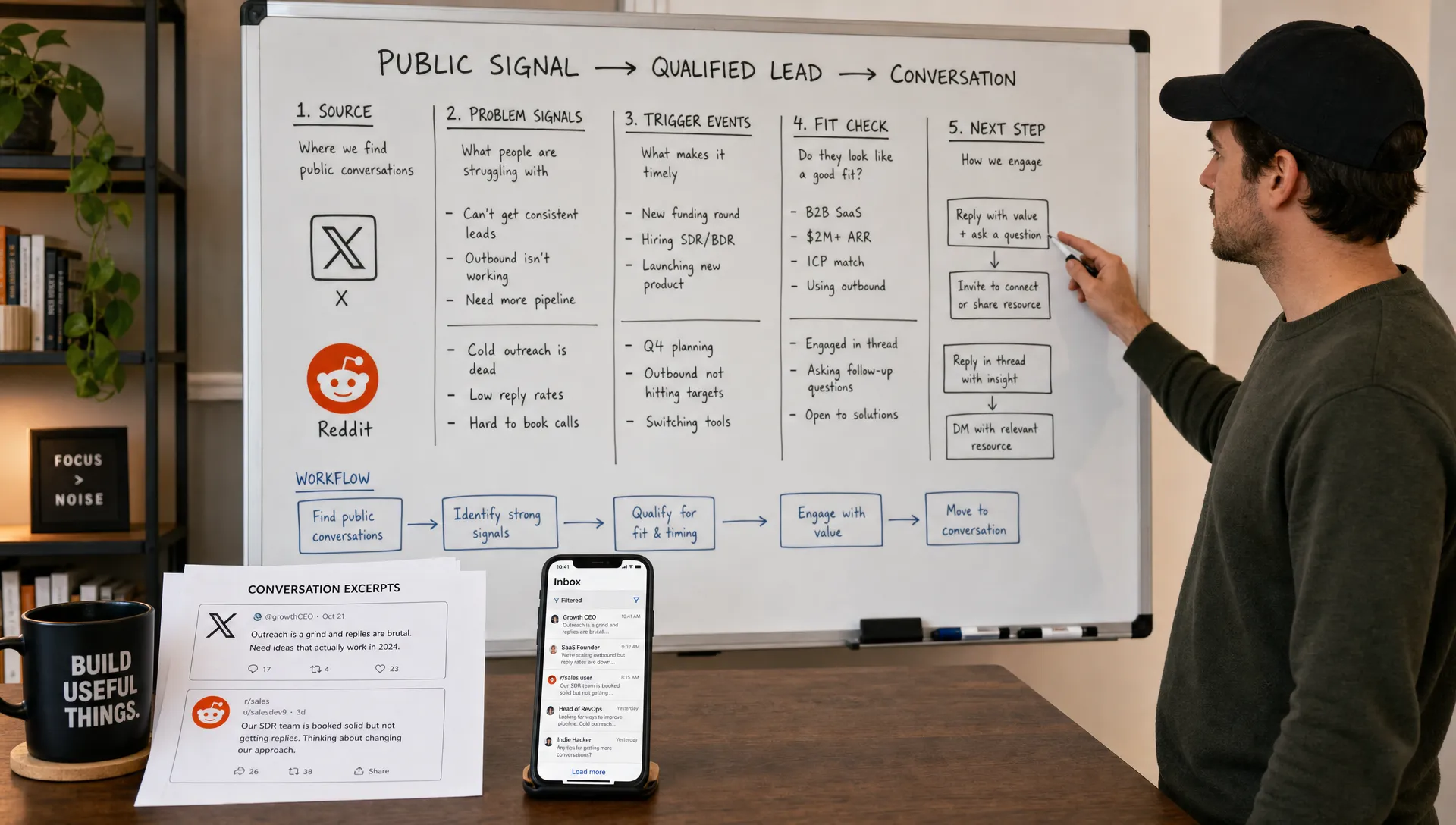
They show up when a founder asks on X, “What are people using for outbound enrichment now?” They show up when an operator posts on Reddit, “Has anyone found a better way to track customer onboarding tasks?” They show up when a team complains publicly about a workflow your product solves.
That is the foundation of business to business lead generation with zero ad spend: finding real buyer intent in public conversations, answering with relevance, and turning helpful engagement into qualified pipeline.
This does not mean “free” in the sense that it costs nothing. It costs focus, consistency, and good judgment. But it does mean you can generate leads without buying traffic, renting attention, or waiting months for SEO to compound.
The zero-ad mindset: stop chasing impressions, start finding intent
Most ad-driven lead generation starts with a broad audience. You define a role, industry, company size, or keyword group, then pay to get in front of people who might care.
Zero-ad B2B lead generation works in the opposite direction. You start with observable intent.
Instead of asking, “Who could be our buyer?” you ask, “Where are people already describing the problem we solve?”
That distinction matters because small teams rarely lose because they lack reach. They lose because they spend too much time reaching the wrong people. A founder with 300 relevant conversations can often outperform a team blasting generic campaigns at 30,000 contacts.
Good zero-ad lead generation usually has four traits:
- It is intent-led, not audience-led.
- It is based on public signals, not private scraping or spam.
- It prioritizes helpful replies over hard pitching.
- It improves over time as you learn the exact language buyers use.
This is why platforms like X and Reddit are so useful. People ask for recommendations, compare tools, vent about broken workflows, request examples, and share failed attempts in their own words. Those signals are messy, but they are often much closer to buying intent than a demographic filter.
If you want a deeper tactical breakdown of this motion, Pounce has a related guide on marketing lead generation without ads or cold DMs, focused specifically on monitoring public conversations and replying in context.
Where zero-spend B2B leads actually come from
A zero-ad strategy does not mean “post and hope.” It means building repeatable systems around places where demand already surfaces.
For most B2B teams, the highest-leverage sources are public social conversations, communities, partner networks, customer referrals, founder-led content, and product-led entry points. The trick is not doing all of them at once. It is choosing one or two channels where your buyers already reveal pain.
X and Reddit conversations
X is useful for real-time buying signals, founder-to-founder recommendations, and category chatter. Reddit is useful for detailed pain points, tool comparisons, troubleshooting threads, and candid objections.
A prospect may not say, “I am ready to buy procurement software.” But they might say, “Our approval process is a mess and finance keeps losing requests.” That is often enough to start a useful conversation.
Existing customers and warm networks
Zero ad spend should not mean zero relationship leverage. Customer referrals, partner intros, and alumni networks can be powerful, especially if you make the ask specific.
Instead of “Do you know anyone who needs us?” ask, “Do you know any RevOps leaders at Series A SaaS companies struggling with messy CRM handoffs?” Specificity makes referrals easier.
Search and community questions
Your audience is already asking questions in niche forums, Slack groups, Discord communities, LinkedIn comments, Reddit threads, and product communities. Answering those questions well can create direct leads and content ideas.
The key is to separate visibility work from pipeline work. A thoughtful public answer can build visibility. A reply to someone actively asking for a solution can create pipeline.
Build an intent map before you start replying
Before you monitor conversations, define what a good lead signal looks like. Otherwise, you will drown in noise.
An intent map is a simple document that translates your ICP into the words, complaints, and moments that indicate potential demand. It helps you avoid chasing every mention of your category.
For example, if you sell customer onboarding software, weak signals might include “customer success,” “onboarding,” or “SaaS retention.” Strong signals might include “new customers keep getting stuck,” “we need a better onboarding checklist,” or “our CSM handoff is too manual.”
| Signal type | What it sounds like | How to treat it |
|---|---|---|
| Problem signal | “We keep losing track of client requests.” | Reply with diagnosis and a practical next step. |
| Recommendation request | “What tools do people use for this?” | Offer a short shortlist and disclose your relevance if appropriate. |
| Competitor frustration | “We tried X but it is too complex.” | Ask what failed, then share a lighter alternative or framework. |
| Trigger event | “Just hired our first sales team.” | Share advice tied to the timing, not a generic pitch. |
| Education question | “How should we think about this process?” | Teach first, then invite a deeper conversation if useful. |
A strong intent map should include negative signals too. If someone is a student doing research, a consumer asking a personal question, or a company far outside your market, do not force it.
A simple zero-ad B2B lead generation system
The most effective system is boring by design. You do not need a 40-step funnel. You need a daily motion that surfaces relevant conversations, helps you respond quickly, and captures learning.
Step 1: Define the lead you actually want
Start with a narrow ICP. Not “B2B companies.” Not “marketers.” Not “SaaS teams.” Choose a specific buying context.
A useful ICP definition includes:
- Company type and stage
- Buyer role or user role
- Trigger event
- Pain that creates urgency
- Existing workaround or competitor
- Reason they would act now
For example: “Seed-stage B2B SaaS founders who are starting founder-led sales, have no SDR team, and are looking for ways to find high-intent prospects without cold outbound.”
That is a far better target than “SaaS founders.” It gives you language to monitor and a reason to engage.
Step 2: Monitor conversations where intent appears
Once your ICP is clear, create search rules around problems, alternatives, workflows, and buying phrases.
Search for phrases like:
- “looking for a tool to”
- “how do you handle”
- “any recommendations for”
- “alternatives to”
- “struggling with”
- “what are people using for”
- “is there a better way to”
The value is not just finding mentions of your product category. The value is finding people describing the job they need done.
Pounce is built for this kind of workflow: it monitors X and Reddit in real time, filters conversations with AI, surfaces relevant posts in an inbox, and helps draft replies so you can run focused 15-minute sessions instead of doom-scrolling for leads.
Step 3: Qualify before you engage
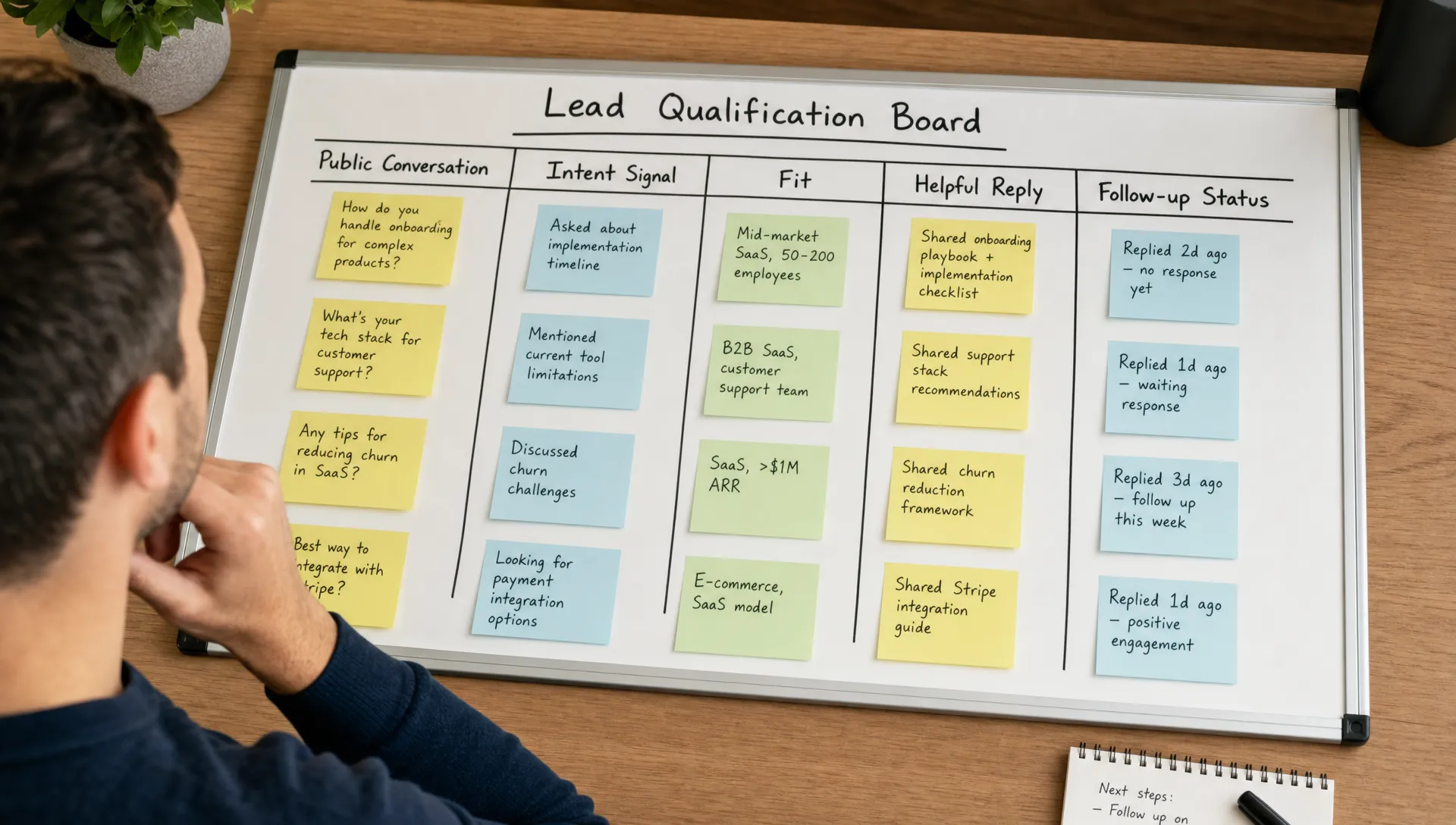
Not every relevant post deserves a reply. Before jumping in, check whether the person or company matches your ICP, whether the pain is current, and whether your answer can genuinely help.
A good lead often has at least two of these signals: a clear problem, urgency, a role connected to the problem, evidence of budget or business impact, and openness to recommendations.
A poor lead may mention your keyword but lack context, urgency, or fit.
Step 4: Reply like an expert, not a salesperson
Your first reply should not feel like an ad. It should feel like the most useful answer in the thread.
A good reply usually does three things:
- Names the problem accurately.
- Gives one practical recommendation.
- Opens a low-pressure next step.
For example:
“Usually this breaks when onboarding tasks live across email, Slack, and spreadsheets. I’d start by mapping the 5 handoffs that happen in every account, then assign one owner per handoff. If helpful, I can share the checklist we use for this.”
That reply earns attention because it is specific. It does not demand a demo. It gives value first.
If the context makes your product relevant, disclose it naturally: “I’m building in this space, so I’m biased, but…” or “We solve a version of this for small CS teams, and the pattern we see is…”
Step 5: Move to a conversation only when there is a reason
The goal is not to keep every interaction public forever. The goal is to earn the right to go deeper.
A private message, call, or demo invite makes sense when the person asks for details, shares more context, wants a recommendation, or clearly has the problem you solve.
Avoid the lazy transition: “DM me.” Instead, make the next step useful.
Try: “If you want, send me what your current workflow looks like and I’ll point out where it is probably breaking.”
Or: “Happy to share a quick comparison if you’re evaluating tools. The right choice depends on whether you need reporting, handoffs, or customer-facing tasks most.”
What to say when you have no brand authority yet
Many zero-ad strategies fail because founders assume they need a big audience before they can generate leads. You do not.
You need credibility in the reply itself.
If you are early, lean on clarity, specificity, and proof of thought. You can build authority by explaining tradeoffs, naming patterns, and asking unusually good questions.
Weak reply: “We can help with this. Check us out.”
Strong reply: “If your issue is low reply rates, I’d first separate list quality from message quality. Send 20 highly specific messages to people showing intent and compare that against your current broad list. If the specific batch wins, your problem is targeting, not copy.”
The second reply proves expertise without requiring a famous logo.
For founders and marketers building their AI-assisted workflows, resource libraries such as AIMarketer Hub can also be useful for prompts, marketing tools, and practical automation ideas that support this kind of lean growth system.
The 15-minute daily workflow
Consistency beats marathon prospecting. A focused daily session can produce better results than sporadic bursts of outreach.
Here is a practical 15-minute workflow for business to business lead generation without ads:
| Minute | Action | Goal |
|---|---|---|
| 0-3 | Review surfaced conversations | Find the highest-intent posts first. |
| 3-6 | Qualify fit | Ignore noise and low-fit mentions. |
| 6-12 | Draft and post helpful replies | Add value while the conversation is fresh. |
| 12-14 | Save promising leads | Track who needs follow-up and why. |
| 14-15 | Note patterns | Improve search rules and messaging. |
This works because speed matters. On X and Reddit, the best answer often wins early attention. If you arrive days later, the buyer may have already chosen a tool, received recommendations, or lost interest.
That does not mean you need to live online. It means you need a repeatable way to find the right posts quickly. Pounce’s daily reply goals, session stats, AI-powered filtering, and inbox for relevant posts are designed around that exact behavior: short, focused sessions that help you engage before conversations go cold.
If speed is your main challenge, this guide on finding B2B sales leads before your competitors do expands on how to spot early buying intent before it becomes obvious to everyone else.
How to measure zero-ad lead generation
Zero-ad does not mean unmeasured. In fact, you need tighter measurement because you are investing time instead of media budget.
Track the whole path from signal to revenue, not just replies.
Useful metrics include:
- Relevant conversations found per week
- Qualified conversations as a percentage of total surfaced posts
- Replies sent
- Reply-to-conversation rate
- Conversations moved to DM or email
- Calls booked
- Opportunities created
- Revenue influenced
- Common objections or repeated pain points
The key metric is not volume. It is qualified conversations per hour.
If you spend five hours and send 100 replies that produce no conversations, something is wrong. Your intent signals may be too broad, your ICP may be vague, or your replies may sound generic.
If you spend 75 minutes across a week and create five meaningful conversations with high-fit prospects, the system is working even if the raw numbers look small.
Common mistakes that make zero-ad lead gen fail
The strategy is simple, but simple does not mean effortless. Most teams make one of a few predictable mistakes.
They monitor keywords instead of intent
A keyword match is not a lead. Someone mentioning “CRM” may be writing a tutorial, complaining as an end user, or discussing a stock ticker. Intent requires context.
Look for pain, urgency, role fit, and a reason to act.
They pitch too early
If your first reply reads like campaign copy, it will be ignored. Public conversations reward relevance. Lead with diagnosis, examples, or a useful next step.
For a deeper look at tone, Pounce’s guide to lead gen marketing that feels helpful, not pushy is worth reading before you start replying at scale.
They chase every possible buyer
Zero-ad lead generation works best when narrow. If you try to engage every industry, role, and pain point, your replies become vague. Narrow targeting makes your answers sharper.
They do not improve their filters
Your first set of search rules will be imperfect. That is normal. The advantage comes from learning which phrases produce real opportunities and which phrases produce noise.
Pounce includes automatic filter improvement, which helps refine the conversations surfaced over time. Even if you run the process manually, schedule time each week to update your rules based on what actually converted.
When zero ad spend is enough, and when it is not
Zero-ad lead generation is especially effective when your market is niche, your buyer is active in public communities, your problem is easy to recognize in conversation, and your team can respond with expertise.
It is less effective when buyers never discuss the problem publicly, the purchase is highly confidential, or your category requires broad market education before people understand the pain.
Even then, zero-ad work can support other channels. The conversations you find can inform website copy, sales scripts, content strategy, product positioning, and ad creative if you later decide to spend.
That is one of the hidden benefits: you are not just generating leads. You are building a live research engine around your market.
A practical starter plan for the next 7 days
If you want to start this week, keep it lightweight.
Day one, define one ICP and write 20 pain phrases they might use. Day two, search X and Reddit manually and save real examples. Day three, turn the best examples into search rules. Day four, reply to five relevant conversations with no pitch. Day five, refine your rules based on what was noisy. Day six, follow up where the conversation continued. Day seven, review what you learned and decide whether the channel deserves a daily 15-minute habit.
The goal of week one is not to close a flood of deals. It is to prove that your buyers are talking, your team can identify intent, and your replies can create conversations.
Once that is true, the system becomes easier to scale.
FAQ
Can B2B companies really generate leads with zero ad spend?
Yes. Many B2B companies generate leads through public conversations, referrals, partnerships, founder-led content, communities, and direct helpful engagement. The key is to focus on high-intent signals instead of broad visibility.
What is the best zero-ad channel for business to business lead generation?
The best channel is where your buyers already describe their problems. For many SaaS companies, agencies, and consultants, X and Reddit are strong because buyers ask for recommendations, compare tools, and discuss pain points publicly.
How many replies should I send per day?
Quality matters more than volume. A good starting goal is 5 to 15 thoughtful replies per day to conversations that match your ICP and show real intent. One excellent reply to the right buyer is worth more than 50 generic comments.
Should I use AI for B2B lead generation?
AI is useful for monitoring conversations, filtering noise, drafting replies, and improving search rules. It should not replace human judgment. The best results come from using AI to move faster while keeping replies specific, accurate, and genuinely helpful.
How long does this strategy take to work?
You can often start conversations within days if your buyers are active publicly and your intent map is clear. Turning those conversations into pipeline depends on your sales cycle, offer, follow-up, and how urgent the problem is.
Turn public intent into pipeline
Business to business lead generation with zero ad spend is not about being everywhere. It is about being present when the right person is already asking the right question.
If your buyers are talking on X or Reddit, you do not need to wait for them to click an ad. You can listen for intent, reply with value, and build relationships before competitors even know an opportunity exists.
Pounce helps you do that in focused 15-minute sessions by monitoring X and Reddit, filtering for relevant conversations, surfacing leads in an inbox, and helping you draft replies faster. Start with one ICP, one daily session, and one goal: become the most useful person in the conversation.