Why speed matters in B2B lead generation now
The best B2B sales leads usually show up before they look like leads.
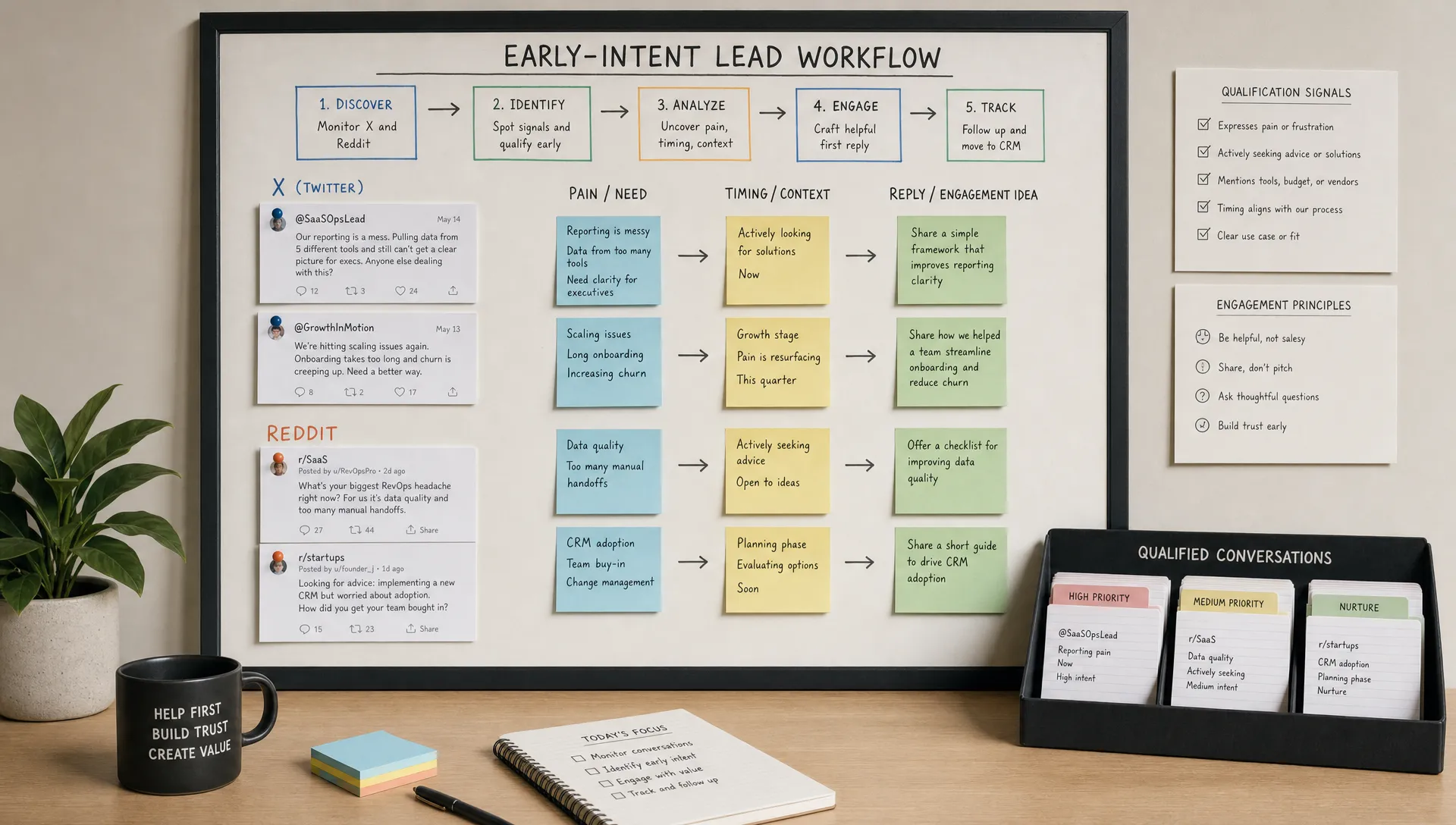
A founder complains on X that their reporting process is breaking. A RevOps manager asks Reddit which tool can replace a spreadsheet. A VP of Operations replies to a thread about onboarding bottlenecks. None of these people has filled out a demo form yet, but they are already revealing pain, urgency, and context.
That is the window your competitors miss.
Finding B2B sales leads before competitors is not about being more aggressive. It is about building a system that spots early buying intent in public conversations, qualifies it quickly, and helps you respond with something useful while the buyer is still forming their opinion.
For lean sales and marketing teams, this is especially powerful. You may not have the biggest ad budget, the largest outbound team, or the most recognized brand. But you can be closer to the market than everyone else if you know where to listen.
What it means to find leads before competitors do
Most teams define a lead too late. They wait for a form fill, a webinar registration, a product-led signup, or an inbound request. Those signals are useful, but by then the buyer may have already read competitor content, asked peers for recommendations, or built a shortlist.
Early lead discovery means identifying people and accounts when they are still in the messy, exploratory stage. They have a problem, but not always a preferred solution. They are asking peers, venting about workflows, comparing options, or trying to understand what is possible.
Here is how early signals compare with traditional lead signals:
| Signal type | What it looks like | Competitive pressure | Best response |
|---|---|---|---|
| Early problem signal | Someone describes a pain, bottleneck, or broken workaround | Low | Help them clarify the problem and share a practical next step |
| Active research signal | Someone asks for tool recommendations or alternatives | Medium | Explain tradeoffs and offer a relevant example |
| Vendor comparison signal | Someone compares named solutions | High | Address the criteria they care about without attacking competitors |
| Inbound form signal | Someone books a demo or downloads an asset | Very high | Follow up fast with personalized context |
The earlier you enter the conversation, the less you need to compete on volume. You are not one of ten vendors in an inbox. You are the helpful person who understood the problem when it first became visible.
Start with a sharper definition of your ideal lead
Before you monitor anything, tighten your definition of what a good lead sounds like. Not just who they are, but what they say when they are close to needing you.
A useful lead definition has five parts:
- Buyer profile: The role, company type, industry, team size, or business model that most often buys from you.
- Pain language: The phrases buyers use before they know your category name.
- Trigger events: Changes that make the problem urgent, such as hiring, launching, scaling, migrating, or replacing manual work.
- Bad-fit exclusions: Students, job seekers, hobbyists, tiny use cases, or companies outside your market.
- Next-best action: The reply, resource, question, or offer that would genuinely help if the signal is real.
This matters because buyers rarely describe problems in your preferred marketing language. They do not always say they need sales intelligence, lifecycle automation, field service software, or pipeline acceleration. They say things like: our spreadsheet is chaos, has anyone solved this, what are people using for this workflow, or is there a better way to track this?
For example, if you sell into field-service businesses, you would not only monitor broad terms like CRM. You would listen for operational pain around scheduling, technician coordination, billing, route changes, or customer communication. A vertical platform such as SplashIQ for pool service companies is a useful example of how specific workflow language can reveal buying intent long before someone searches for software.
Monitor the places where intent appears first
For many B2B categories, early demand shows up in public before it shows up in your CRM. X and Reddit are especially useful because people post in the moment. They ask peers, describe constraints, complain about tools, and share buying criteria in plain language.
Reddit is often stronger for detailed problem discovery. Subreddits create natural context around roles, industries, tools, and workflows. A single thread can reveal the buyer’s use case, budget sensitivity, objections, and alternatives under consideration.
X is often stronger for speed. People post quick complaints, ask for recommendations, discuss launches, react to competitors, and join niche professional conversations. The half-life of a post can be short, which makes real-time monitoring valuable.
If your team wants a broader channel framework, Pounce has a dedicated guide to building a lead generation strategy for X and Reddit in 2026. The key idea is simple: do not wait until buyers arrive on your website. Meet them where they are already asking questions.
Create search rules around intent, not just keywords
Most teams make the mistake of monitoring only obvious keywords. That produces noisy feeds and misses buyers who describe the problem differently.
A better system combines category terms, pain phrases, competitor mentions, and trigger language. You want rules that catch the moments when someone is likely to welcome help.
| Rule type | Example phrases to monitor | What it can reveal |
|---|---|---|
| Pain-based rules | struggling with, tired of, spreadsheet for, manual process, keeps breaking | A problem exists, even if the buyer has not named a solution category |
| Recommendation rules | best tool for, anyone using, what do you use for, alternatives to | The buyer is actively researching options |
| Competitor rules | switching from, cheaper than, frustrated with, does anyone use | Dissatisfaction, comparison, or replacement intent |
| Trigger rules | just hired, scaling, launching, migrating, new team, first sales hire | Timing that could create urgency |
| Budget and approval rules | worth paying for, budget for, founder-approved, procurement | Commercial readiness or constraints |
The best rules are specific enough to reduce noise but flexible enough to catch natural language. For example, monitoring CRM alone is too broad. Monitoring what do you use to track renewals or spreadsheet for customer follow-up is much closer to intent.
This is where AI can help, but only if the strategy is clear. Pounce uses customizable search rules and AI-powered filtering to surface relevant posts from X and Reddit, so you are not manually refreshing feeds or sorting through hundreds of low-fit mentions.
Score conversations before you reply
Speed matters, but not every conversation deserves your time. The goal is to reply quickly to the posts most likely to become real opportunities.
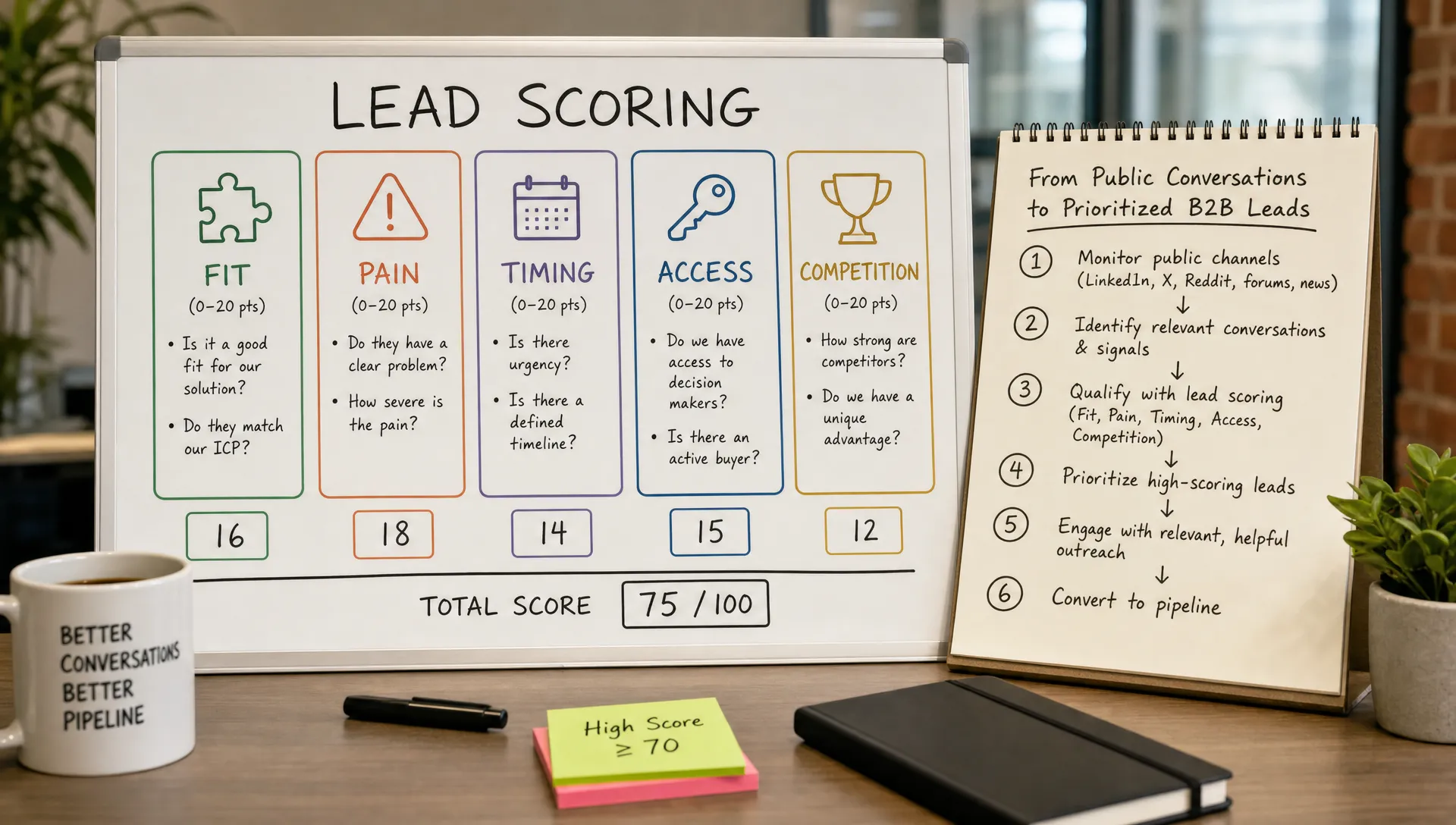
Use a simple scoring model before engaging:
| Criterion | 0 points | 1 point | 2 points |
|---|---|---|---|
| Fit | Wrong audience or unclear context | Possible fit | Clear ICP match |
| Pain | Casual mention | Mild frustration or curiosity | Specific painful problem |
| Timing | No urgency | Exploring options | Needs a solution soon |
| Access | Hard to engage naturally | Reply could help | Direct question or open request |
| Competition | Vendor thread already crowded | Some vendor attention | Few or no helpful replies yet |
A post with 7 to 10 points should be prioritized. A post with 4 to 6 points may be worth saving or watching. Anything below that is usually noise unless the account is strategically important.
This scoring also prevents the biggest mistake in social lead generation: replying to everything. When you engage with low-fit posts, you waste time and train yourself to chase activity instead of pipeline.
Reply like a peer, not a vendor
Once you find a high-intent conversation, the reply determines whether you create trust or get ignored.
The best first reply usually does three things. It acknowledges the specific situation, adds useful context, and opens a low-pressure next step. It does not immediately force a demo, drop a generic pitch, or paste a feature list.
A strong reply might follow this structure:
- Name the problem in their words.
- Share one practical observation or tradeoff.
- Ask a clarifying question.
- Mention your product only if it is clearly relevant.
For example, if someone asks how to replace a messy spreadsheet process, a weak reply says: We solve this, book a demo. A stronger reply says: The hardest part is usually not the spreadsheet itself, it is getting the team to trust one source of truth. Are you mainly trying to fix reporting, handoffs, or follow-up ownership?
That kind of reply earns the next exchange. It also helps other people in the thread, which can create secondary leads.
If you want more examples of this approach, Pounce’s guide to lead gen marketing that feels helpful, not pushy goes deeper on qualifying conversations before introducing your product.
Turn lead discovery into a 15-minute daily workflow
Finding leads before competitors is less about marathon prospecting sessions and more about consistent market attention. A focused daily workflow can outperform sporadic outreach because you catch conversations while they are still fresh.
A practical 15-minute routine looks like this:
| Minute | Action | Goal |
|---|---|---|
| 0 to 3 | Review your highest-priority X and Reddit posts | Start with the best-fit opportunities |
| 3 to 7 | Score each conversation quickly | Separate leads from noise |
| 7 to 12 | Draft and personalize replies | Be helpful while the thread is active |
| 12 to 15 | Save follow-ups and adjust rules | Improve tomorrow’s signal quality |
Pounce is built around this kind of workflow: real-time X and Reddit monitoring, an inbox for relevant posts, AI-assisted reply drafting, daily reply goals, session stats, and automatic filter improvement. The point is not to automate relationships. It is to make sure the right conversations reach you fast enough to matter.
For a more tactical morning routine, see Pounce’s guide on how to find accounts worth replying to every morning.
Follow up without killing the momentum
The first reply is not the finish line. It is the start of a conversation.
If the person responds, stay in context. Answer their question, ask about their constraints, and avoid jumping too quickly into a sales motion. If your product is relevant, make the transition naturally: I can share how we think about this, or happy to send a quick example if useful.
When moving to DMs or email, ask permission when possible. This is especially important on Reddit, where communities are sensitive to self-promotion. A simple public reply that says, happy to send a template if you want it, often performs better than an unsolicited private message.
Track the conversation in your CRM or sales notes with the original pain, channel, thread URL, and next step. The public post is valuable context. It tells you what the buyer cared about before they ever entered a formal sales process.
Common mistakes that let competitors catch up
Even teams that understand intent-based lead generation can lose the advantage through poor execution.
The first mistake is monitoring too broadly. If your feed is full of irrelevant posts, your team will stop trusting it. Narrow the rules until most surfaced conversations are at least plausible.
The second mistake is replying with generic messaging. Public conversations reward specificity. If your reply could fit any thread, it probably will not stand out in this one.
The third mistake is over-qualifying before engaging. You do not need perfect firmographic data to be helpful. If the pain is clear and the person is asking for input, a thoughtful reply can create the context you need.
The fourth mistake is ignoring learning loops. Every bad match should improve your filters. Every good conversation should teach you new phrasing, objections, and trigger language.
FAQ
What are B2B sales leads?
B2B sales leads are people or accounts that may become customers for a business-to-business product or service. The best leads usually show signs of fit, pain, timing, and openness to a conversation.
Where can I find B2B sales leads before competitors?
You can find early B2B sales leads in public conversations on platforms like X and Reddit, especially when people ask for recommendations, complain about workflows, compare tools, or describe urgent business problems.
How do I know if a public post is a real lead?
Look for four signals: the person matches your ideal customer profile, the pain is specific, the timing seems active, and there is a natural way to reply helpfully. If those signals are present, the post is worth prioritizing.
Should I pitch my product in the first reply?
Usually, no. Start by being useful. Answer the question, clarify the problem, or share a relevant tradeoff. Mention your product only when it directly fits the situation and would genuinely help the person evaluate a next step.
How often should my team look for new leads?
For most lean teams, a daily 15-minute session is enough to build momentum. The key is consistency. Public conversations move quickly, so checking once a week often means arriving after the best opportunities have already gone cold.
Find the right conversations before they get crowded
Your competitors are probably waiting for intent to become obvious. They are bidding on the same keywords, chasing the same form fills, and responding after buyers have already narrowed their options.
You can get there earlier by listening for real buying signals on X and Reddit, scoring conversations quickly, and replying with context that earns trust.
Pounce helps you do that in focused 15-minute sessions. It monitors X and Reddit in real time, filters for high-intent posts, drafts helpful replies, and keeps your team focused on the conversations most likely to matter.
If you want more B2B sales leads without waiting for your competitors to define the market, start by finding the conversations they are not seeing yet.