
The best marketing leads rarely introduce themselves
Most teams picture a marketing lead as someone who fills out a demo form, downloads a guide, or replies to a campaign. Those people matter, but they are only the leads who have already chosen to enter your funnel.
The more interesting opportunities often appear earlier. They show up as a founder asking for tool recommendations on X, a Reddit user complaining about a broken workflow, or a marketer comparing two vendors in a comment thread. They may not say “I am ready to buy,” but their language reveals a problem, urgency, and openness to advice.
That is what makes hidden marketing leads valuable. They are not invisible because they lack intent. They are invisible because most teams are looking in the wrong places, using the wrong filters, or waiting until the lead becomes obvious to everyone else.
What hidden marketing leads actually look like
A hidden lead is a person or account showing signs that they might need your product, service, or expertise, even if they have not directly asked to be sold to. The signal can be subtle, especially in public conversations where people are trying to get advice rather than enter a sales process.
The key is to look for commercial intent behind everyday language. People rarely describe their problem in your product category’s terms. They describe the frustration, deadline, workaround, or outcome they want.
| What people say publicly | What it may signal | Why it matters |
|---|---|---|
| “How are you all handling this?” | They are looking for a new approach | They may be open to expert guidance |
| “Any alternatives to [tool]?” | They are dissatisfied with a current solution | Competitor pain is a strong timing signal |
| “I’m tired of doing this manually.” | Their workflow is painful or inefficient | Manual work often creates budget justification |
| “Need something that works for a small team.” | They have constraints and selection criteria | Specific constraints make qualification easier |
| “Has anyone used [category] for [use case]?” | They are evaluating options | Peer validation often happens before vendor outreach |
| “We’re launching next month and need to figure out…” | They have urgency | Deadlines increase the chance of action |
The mistake is treating these as casual comments. In reality, they can be early buying moments. If you respond while the conversation is still active, you can help shape how the person thinks about the problem before they build a vendor shortlist.
Separate real intent from casual curiosity
Not every question is a lead. Some people are researching for a blog post, asking out of curiosity, or debating without any plan to act. Good lead spotting starts with qualification.
A useful marketing lead usually has at least three of these five traits: pain, urgency, fit, ownership, and openness.
| Intent factor | What to look for | Example clue |
|---|---|---|
| Pain | A real problem, not a vague interest | “This is slowing down our sales team every week.” |
| Urgency | A deadline, recent trigger, or active search | “Need to solve this before our next launch.” |
| Fit | The person or company resembles your target customer | Their bio, role, company size, or use case matches your ICP |
| Ownership | They can influence or make a decision | “I’m choosing the tool for our team.” |
| Openness | They ask for recommendations or advice | “What would you use if you were starting over?” |
A weak signal might be “What is the best CRM?” A stronger signal is “We’re a 6-person agency outgrowing spreadsheets, and I need a CRM that handles client follow-up without adding admin work.”
The second post gives you pain, team size, current workaround, desired outcome, and likely buying intent. That is the difference between a keyword match and a lead.
Where marketing leads hide in public conversations
Hidden leads are rarely found on your own website first. They often appear in the places people already trust for fast, unfiltered advice.
On X, buying signals show up in posts, quote posts, replies, and founder-to-founder conversations. Someone might complain about a workflow, ask for a recommendation, or react to a competitor’s announcement. Because X moves quickly, speed matters. A helpful reply within the first hour can get more attention than a perfect reply the next day.
On Reddit, leads often hide deeper in threads. A post may start as a broad question, but the strongest signal appears in a comment where someone explains their situation in detail. Subreddits organized around roles, industries, tools, and business problems can surface incredibly specific buyer language.
This is why real-time monitoring beats occasional searching. If you only search manually once a week, you find conversations after the moment has passed. Pounce was built around this problem, using real-time X and Reddit monitoring to surface relevant conversations so teams can respond while the window is still open. If you want to go deeper on timing, this breakdown of why real-time monitoring is the shortcut to better leads explains the advantage clearly.
Search for buyer language, not just product keywords
The best leads do not always use the words your marketing team uses. If you sell project management software, a buyer may not post “best project management platform.” They might say “our team is missing deadlines because everything is in Slack.” If you run an agency, a prospect may not say “looking for a marketing agency.” They might say “we are getting traffic but no qualified demos.”
To spot more marketing leads, build your search rules around problem language. Think in terms of symptoms, workarounds, comparisons, and triggers.
Useful phrase patterns include:
- “How do you handle…”
- “What are you using for…”
- “Any recommendations for…”
- “Alternative to…”
- “Tired of manually…”
- “Struggling with…”
- “Need a way to…”
- “Is there a tool that…”
- “Has anyone solved…”
You can also monitor competitor names, category terms, job-to-be-done phrases, and negative sentiment. For example, “too expensive,” “hard to set up,” “missing feature,” “bad support,” and “switching from” can all reveal opportunity.
The goal is not to collect every mention. The goal is to catch the conversations where your team can add context, answer a question, or point someone toward a better path.
Read the conversation around the signal
A keyword alone is not enough. A post that says “best email tool?” could be high intent, low intent, or completely irrelevant depending on the context.
Before you treat someone as a lead, read the surrounding conversation. Look at who is asking, what prompted the question, what replies they engage with, and whether they add more detail. A person who responds to follow-up questions with specifics is usually more serious than someone who drops a vague question and disappears.
The same applies to Reddit. The original post might be broad, but a comment like “We tried three tools and still cannot get clean attribution across channels” is far more valuable. It shows experience, pain, and a specific unmet need.
| Surface signal | Context that improves quality | Lead interpretation |
|---|---|---|
| “Any tools for this?” | They describe current workflow and constraints | Active exploration |
| “X is annoying” | They mention switching or budget impact | Potential competitor displacement |
| “How would you solve this?” | They answer clarifying questions | Open to advice |
| “We need this soon” | They mention a launch, hire, or client deadline | Higher urgency |
| “Just curious” | No role, company, timeline, or pain | Likely low priority |
This context-first approach prevents two common problems: chasing poor-fit leads and sounding pushy in conversations that are not commercial.
Build a simple lead-spotting workflow
You do not need a complex demand generation machine to start finding hidden leads. You need a repeatable habit that helps you notice the right signals and act quickly.
Start with your ideal customer profile. Define the roles, company types, use cases, pains, and moments where your product or service is most relevant. Then translate those into public conversation patterns. A buyer rarely says “I match your ICP,” but they do reveal clues through their role, vocabulary, constraints, and questions.
Next, create a small set of search rules. Include category terms, competitor names, pain phrases, and buying-intent phrases. Keep the first version narrow enough that you can review results quickly. If the inbox is full of irrelevant posts, tighten your rules. If you are missing obvious opportunities, expand them.
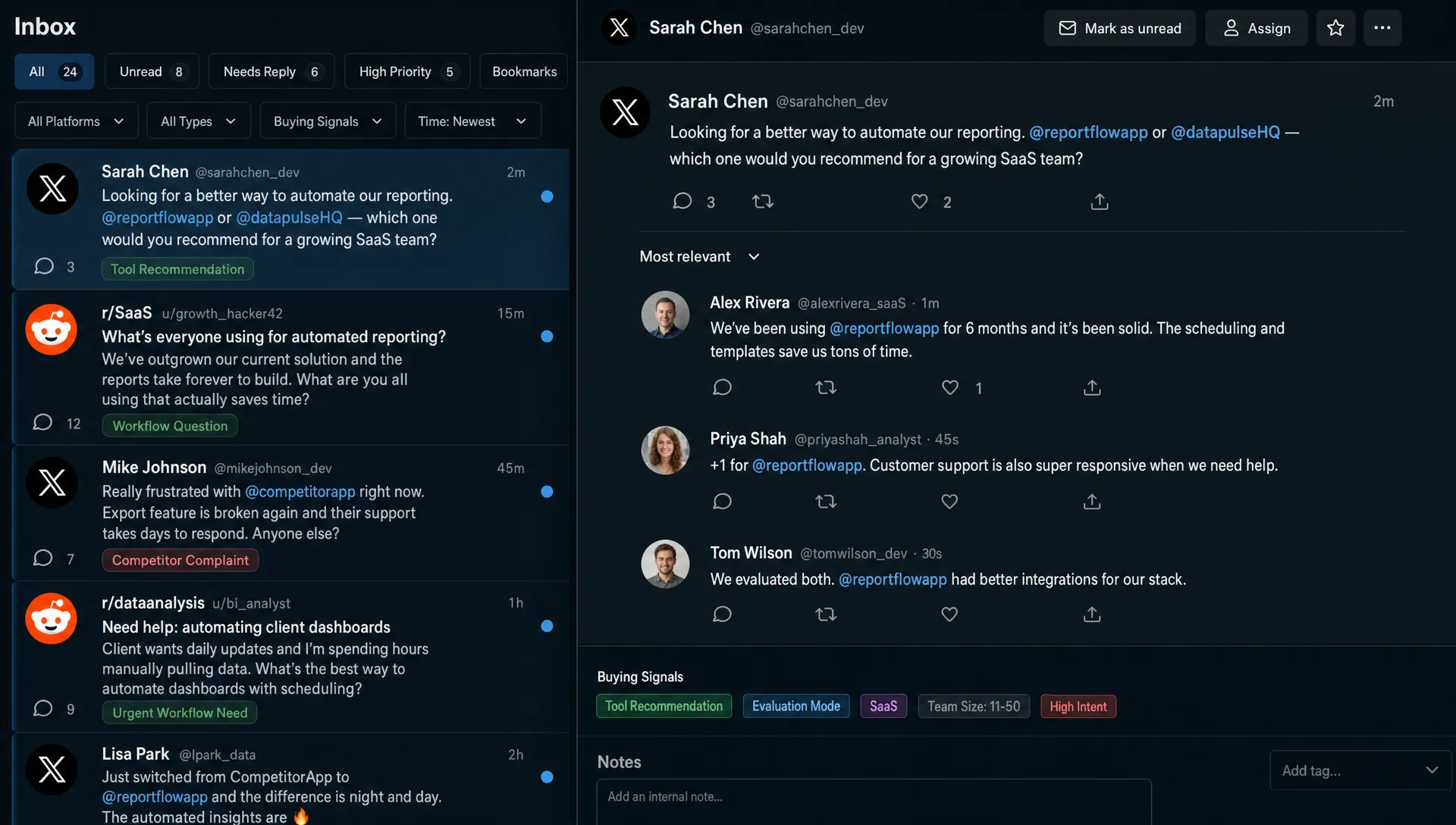
Then set aside a short daily session. Pounce is designed for this kind of workflow: monitor X and Reddit, filter for relevant conversations, review surfaced posts in an inbox, and use AI-assisted reply drafting when you want help shaping a response. The point is not to automate relationships. It is to reduce the time between a high-intent conversation and a useful reply.
If you want a practical approach to timing your responses, this guide on how to generate leads online by replying early pairs well with a lead-spotting routine.
Reply like a helpful expert, not a salesperson
Finding the lead is only half the work. The reply determines whether the person sees you as useful or opportunistic.
The best first response usually does three things: acknowledges the specific situation, gives a practical answer, and invites a natural next step. You do not need to pitch immediately. In fact, pitching too early can turn a warm conversation cold.
A strong reply might look like this:
“Totally get why that is frustrating. If your main issue is tracking which channels create qualified demos, I’d start by separating source data from lifecycle stage data before changing tools. A lot of teams blame the platform when the real issue is inconsistent definitions. What are you using today?”
That reply works because it is specific. It gives the person something useful, shows experience, and asks a relevant question. It also keeps the conversation public and low-pressure.
A weak reply would be:
“We solve this. DM me.”
That may occasionally work, but it usually skips the trust-building step. Public conversations reward helpfulness. If you consistently answer well, other people in the thread may also notice.
For a deeper look at tone, positioning, and non-pushy outreach, see this guide to lead gen marketing that feels helpful.
Score hidden leads before you spend time on them
A simple scoring system keeps you from overreacting to every mention. You do not need a complicated model. You just need a consistent way to decide what deserves a reply, what deserves monitoring, and what should be ignored.
| Score | Signal quality | What it means | Suggested action |
|---|---|---|---|
| 0 | No clear pain or fit | Interesting, but not a lead | Ignore or save for content ideas |
| 1 | Relevant topic, weak intent | Could become useful later | Light reply or monitor thread |
| 2 | Clear pain or question | Worth engaging | Reply with helpful context |
| 3 | Pain plus urgency or competitor dissatisfaction | Strong opportunity | Reply quickly and ask a clarifying question |
| 4 | Pain, urgency, fit, and decision ownership | High-intent lead | Prioritize and continue the conversation |
This is especially helpful for lean teams. If you only have 15 minutes a day, spend it on the conversations with the best combination of fit and timing. A smaller number of high-quality replies will outperform a high volume of generic comments.
Lead scoring also improves your search rules over time. If most surfaced posts score 0 or 1, your monitoring is too broad. If you regularly find 3s and 4s, you are getting closer to the language your buyers actually use.
Common mistakes that make hidden leads disappear
Many teams miss good marketing leads not because they lack tools, but because their process is too slow or too self-centered.
The first mistake is waiting for explicit intent. By the time someone posts “Who should I buy from?” every vendor in the category may be watching. Earlier signals are less obvious, but less crowded.
The second mistake is monitoring only brand mentions. Brand monitoring helps with support and reputation, but it misses people who have the problem your brand solves and simply do not know you yet.
The third mistake is using filters that are too literal. If your searches only include product-category keywords, you miss pain-based language. Buyers talk about jobs to be done, broken workflows, and outcomes more often than they talk about categories.
The fourth mistake is replying without reading the room. Reddit communities in particular can be skeptical of promotional behavior. If your answer would not be useful without your product attached, rewrite it.
When to automate lead spotting, and when to stay human
Automation is valuable when it handles repetitive detection work: monitoring platforms, filtering noisy posts, improving search rules, organizing relevant conversations, and helping draft replies. That is where AI can give a small team more coverage without adding hours of manual searching.
Human judgment matters most in interpretation and relationship-building. You decide whether the person is a fit, whether the thread welcomes vendor input, and how to respond with empathy. The goal is to use AI to get closer to the right conversations, not to remove the human from the conversation.
Some teams also extend signal detection beyond social platforms into enrichment, outreach, and CRM workflows. For that broader motion, an autonomous B2B prospecting platform can complement social-intent lead spotting by helping teams connect buying signals with multichannel sales execution.
For Pounce users, the highest-leverage workflow is often simple: let AI monitor X and Reddit for relevant posts, review the best matches in focused sessions, reply with useful context, and use what you learn to improve future filters.
Turn hidden leads into a repeatable habit
Spotting hidden marketing leads is not about stalking prospects or forcing your way into conversations. It is about paying attention to public signals that already exist and showing up when your expertise is genuinely useful.
The habit is straightforward. Know who you help. Learn how they describe pain. Monitor the places where they ask for advice. Qualify the signal before responding. Reply early, specifically, and helpfully. Track what works, then refine your searches.
Do that consistently and lead generation starts to feel less like chasing strangers and more like joining the right conversations at the right time.
FAQ
What is a hidden marketing lead?
A hidden marketing lead is someone showing potential buying intent without directly filling out a form or asking for a sales call. They might ask for recommendations, complain about a workflow, compare tools, or describe a problem your business can solve.
Where can I find marketing leads hiding in plain sight?
X and Reddit are strong sources because people openly ask peers for advice, share frustrations, and discuss tools. Leads can appear in posts, replies, comments, subreddit threads, and niche community discussions.
How do I know if a public conversation is worth replying to?
Look for pain, urgency, fit, ownership, and openness. If the person has a specific problem, matches your target customer, and seems willing to discuss solutions, the conversation is likely worth a helpful reply.
Should I pitch my product in the first reply?
Usually, no. Start by answering the question or offering useful context. If the person engages, you can naturally mention your product or invite a deeper conversation when it fits.
How can Pounce help spot hidden leads?
Pounce monitors X and Reddit in real time, uses AI-powered filtering to surface relevant conversations, and helps you review and respond during short focused sessions. It is built to help teams find high-intent conversations before they go cold.
Start spotting the leads your competitors miss
Your next best lead may already be asking for help on X or Reddit. The challenge is noticing them quickly enough and replying in a way that earns trust.
Pounce helps you monitor the right conversations, surface high-intent posts, and turn short daily sessions into consistent relationship-building. If you want more pipeline without relying only on ads, cold DMs, or forms, start by finding the leads hiding in plain sight.