Sales conversations start before someone asks to buy
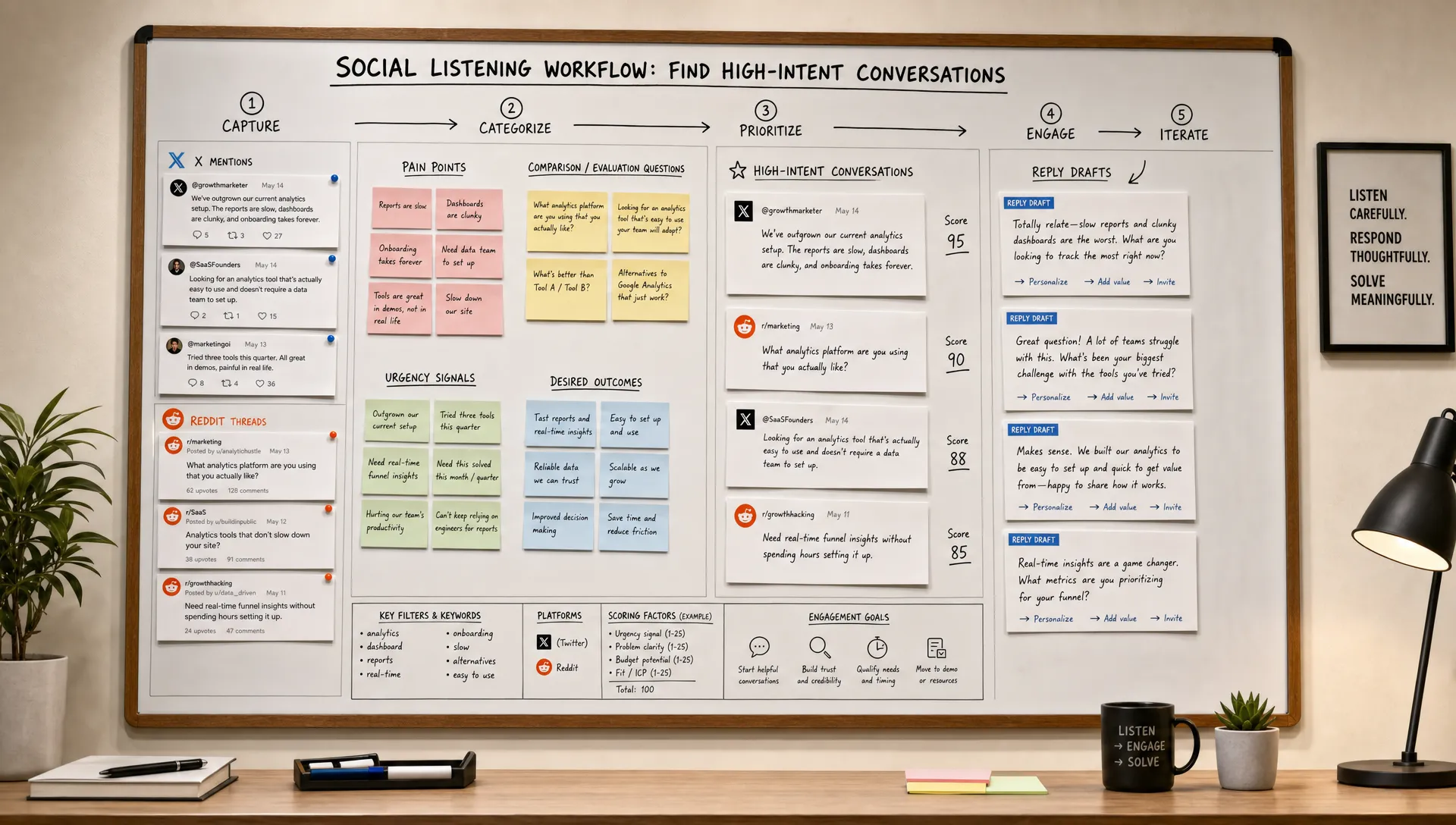
The posts that turn into sales conversations rarely look like sales opportunities at first glance. They look like frustration, curiosity, comparison shopping, tool fatigue, workflow questions, or someone asking peers how they solved a problem.
That is why the goal is not simply to find posts with your keyword in them. The goal is to find posts where a real person is trying to make progress on a problem your product, service, or expertise can help with.
On X and Reddit, those moments happen before a demo request, before a contact form, and often before a buyer has a clear vendor shortlist. If you can spot them early and reply with something useful, you enter the conversation as a helpful operator instead of another salesperson.
This guide breaks down how to find posts that can become real sales conversations, how to qualify them quickly, and how to reply in a way that earns a response.
What makes a post worth replying to?
A post becomes commercially interesting when it combines relevance, intent, and conversational openness. Relevance means the topic matches a problem you can credibly help with. Intent means the person is not just commenting for fun, they are evaluating, struggling, switching, buying, or trying to solve something. Conversational openness means they are likely to welcome input.
That last part matters. Some posts mention your category but are not useful sales opportunities. A viral rant about a broad market problem may generate impressions, but it often does not lead to a buyer conversation. A smaller thread where someone asks for a recommendation, explains a failed workflow, or compares options is usually more valuable.
| Signal | What it looks like | Why it matters |
|---|---|---|
| Problem clarity | Someone describes a specific pain, bottleneck, or failed workaround | Clear pain gives you a natural way to help |
| Active evaluation | The post asks for recommendations, alternatives, examples, or opinions | The buyer is already seeking input |
| Context | They mention team size, role, stack, budget pressure, or current tools | Context helps you qualify fit before replying |
| Recency | The post is fresh and the thread is still active | Early replies are more likely to be seen and answered |
| Openness | The person asks a direct question or responds to others | A two-way conversation is more likely |
This is also why public conversations are becoming a powerful inbound channel. Buyers often reveal pain and intent in the open long before they become an attributed lead. If you want the broader strategy behind this shift, Pounce has a deeper breakdown of why inbound lead generation starts in public conversations.
Build an intent map before you search
Most people search too broadly. They type their product category into X or Reddit, then scroll through a messy feed of news, memes, opinions, and low-fit mentions. That is exhausting, and it makes social selling feel random.
A better approach is to create an intent map. This is a short list of phrases people use when they are close to needing help. Your intent map should include the language of pain, evaluation, switching, and urgency, not just the language of your product.
For example, if you sell customer support software, searching only for customer support software will miss many useful posts. Buyers may say things like support tickets are a mess, Zendesk alternative, how do you manage feature requests, too many customer emails, or need a better help desk setup.
Strong intent maps usually include:
- Pain phrases such as
struggling with,tired of,how do you deal with,manual process, ortakes too long - Evaluation phrases such as
best tool for,recommendations for,anyone using,alternatives to, orworth switching to - Trigger phrases such as
just hired,scaling,migrating,launching,churn, orbudget got cut - Competitor and adjacent-tool phrases that suggest the person is already solving the problem somehow
- Community-specific language that your best buyers actually use, even if it differs from your marketing copy
The more specific your intent map is, the easier it becomes to find posts that deserve a thoughtful reply.
Search where buyers explain the problem
X and Reddit behave differently, so your search strategy should adapt to each platform.
On Reddit, buyers often provide more context. They explain what they tried, what failed, which tools they are considering, and what constraints they have. That makes Reddit especially useful for qualification. You can often tell from the post whether the person is a student, hobbyist, founder, manager, agency owner, or enterprise operator.
On X, buyers often move faster. The best opportunities are short questions, referral requests, complaints, and replies inside active threads. A founder might ask for a recommendation in one sentence, then choose a tool within hours based on who responds first and most helpfully.
Instead of searching for your product category alone, combine category language with intent language. For example:
| Search pattern | Example use case |
|---|---|
recommendation + problem |
Find people asking peers what to use |
alternative + competitor |
Find buyers unhappy with their current option |
how do you + workflow |
Find people trying to solve a repeated operational problem |
tool for + role or use case |
Find posts where the buyer already understands the category |
hate / frustrated / tired of + current process |
Find emotional pain that may create urgency |
The goal is not to create one perfect query. The goal is to build a repeatable system that surfaces relevant conversations every day.
Score each post in 60 seconds
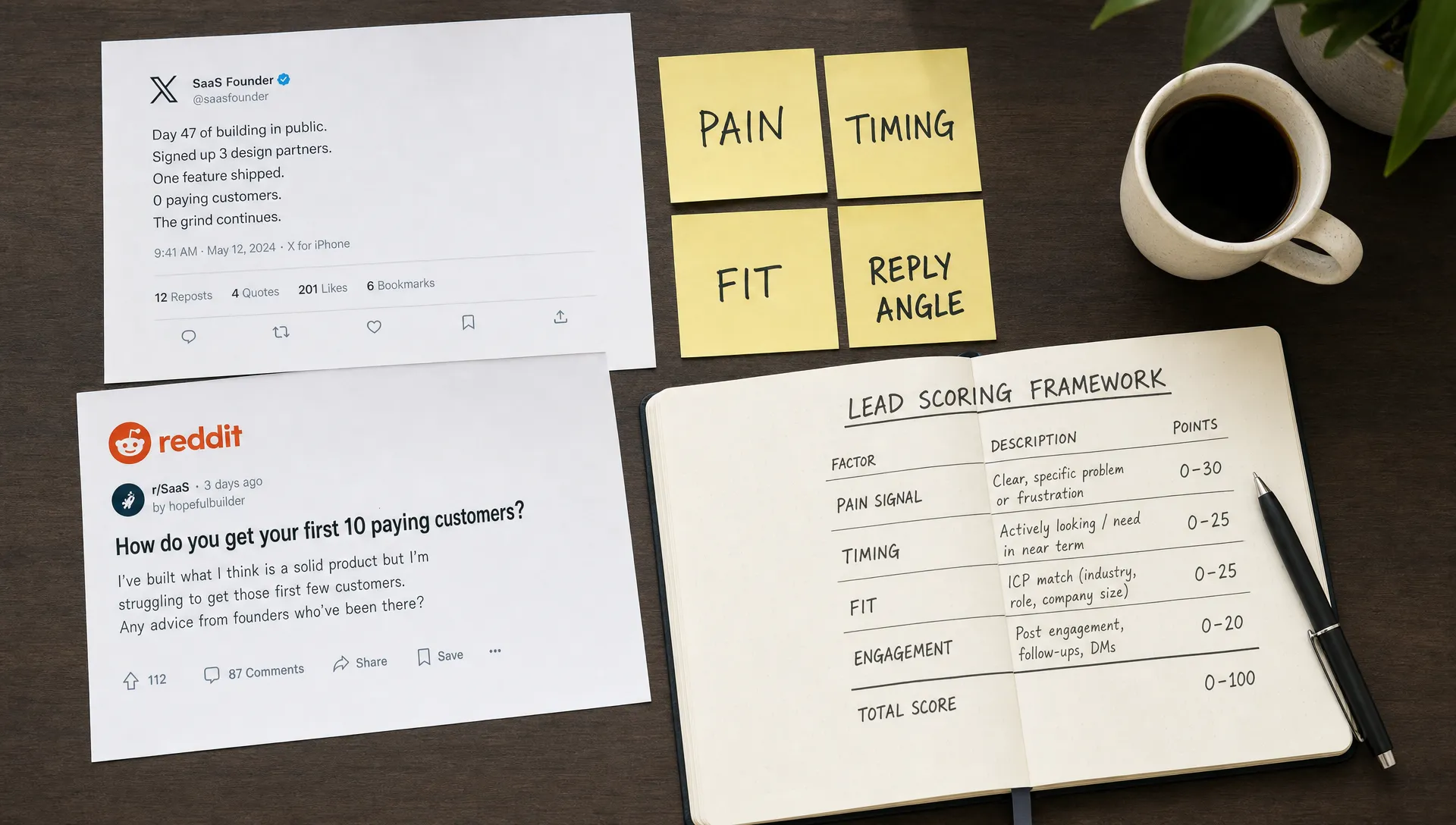
Once you find posts, qualify them before you reply. A fast scoring system keeps you from wasting time on irrelevant threads or replying to posts that will never become conversations.
Use a simple 1 to 3 score for each dimension:
| Dimension | 1 point | 2 points | 3 points |
|---|---|---|---|
| Fit | Broadly related, unclear buyer | Some overlap with your ideal customer | Strong match with your ICP or niche |
| Intent | Casual mention | Researching or asking for examples | Clear pain, urgency, or buying exploration |
| Timing | Old or inactive | Recent but slow | Fresh and actively getting replies |
| Access | Hard to engage naturally | Possible to add context | Direct question you can answer well |
If a post scores low on fit or intent, skip it. If it scores high on timing and access, prioritize it quickly. This is where real-time monitoring matters. A great reply that arrives two days late often performs worse than a good reply that arrives while the thread is still moving.
If timing is a weak spot in your current process, read Pounce’s guide on why replying early can generate leads online. Freshness is often the difference between being useful and being invisible.
Read the thread like a salesperson, not a scraper
Before replying, slow down for one minute and read the context. The post is only the starting point. The replies, profile, subreddit, previous comments, and wording all help you understand what kind of conversation is appropriate.
Look for what the person has already tried. If they say they are using spreadsheets, your reply should not assume they have a complex sales stack. If they mention switching away from a competitor, your reply should speak to migration concerns. If they ask peers for advice, your reply should sound like a peer contribution, not a pitch deck.
This is also where comprehension tools can help. When a prospect references a long article, video, PDF, or dense technical concept, an AI reading companion for clearer understanding can help you process the material faster so your reply addresses the real context rather than a surface-level keyword.
Reply to open the conversation, not close the deal
The first reply should not try to win the sale. It should earn the next response.
A good reply usually does three things. It acknowledges the specific situation, contributes a useful perspective, and asks a low-friction follow-up question. If your product is relevant, you can mention it lightly after giving value, but the reply should still stand on its own.
Here is the difference:
| Weak reply | Better reply |
|---|---|
We built a tool for this. DM me. |
If the main issue is sorting signal from noise, I would separate posts by intent first: recommendation requests, competitor complaints, and workflow pain. Are you trying to find buyers in real time or build a weekly research list? |
Check us out, we solve this. |
This usually breaks when the team tracks keywords instead of buying triggers. I would start with phrases like alternatives to, anyone using, and how do you handle. What audience are you trying to monitor? |
Happy to help. |
One thing I would check before choosing a tool is whether it can filter out low-intent mentions. Lots of monitoring tools find volume, but sales teams need fit plus timing. Is Reddit or X the bigger channel for you? |
Notice that the better replies do not hide commercial relevance. They simply lead with usefulness. That makes the conversation feel natural, and it gives the other person an easy way to continue.
A practical reply structure is:
- Context: Mention the exact problem or constraint from the post
- Insight: Share a useful principle, example, or mistake to avoid
- Question: Ask one specific follow-up that helps qualify the opportunity
- Soft bridge: If relevant, mention that you work on this problem without forcing a pitch
The best replies sound like they came from someone who has seen the problem before.
Turn finding posts into a daily system
Finding one good post is useful. Building a system that finds good posts every day is how this becomes a repeatable growth motion.
Start by saving the posts that led to actual replies, DMs, calls, trials, or sales conversations. Then look for patterns. Which phrases appeared before the best conversations? Which subreddits or X communities produced the highest-fit leads? Which questions got ignored? Which replies created back-and-forth discussion?
Over time, your search rules should become more selective. You want fewer irrelevant mentions and more high-intent posts. That means removing noisy terms, adding negative filters, watching new communities, and updating your language as buyers change how they talk about the problem.
This is exactly the kind of workflow Pounce is built around. Pounce monitors X and Reddit in real time, uses AI-powered filtering to surface relevant posts, helps draft replies, and gives you an inbox for conversations worth acting on. It is designed for quick daily sessions, so you can spend less time scrolling and more time replying to people who are already expressing intent.
Common mistakes that kill sales conversations
The biggest mistake is chasing volume. More posts do not automatically mean more pipeline. If the posts are low intent, old, or poorly matched to your offer, they create busywork instead of conversations.
Another mistake is replying like every post is a lead. Some people are venting. Some are doing academic research. Some are too early. Some are not your buyer. Qualification protects your reputation and your time.
Watch out for these patterns:
- Pitching too early before proving you understand the problem
- Ignoring context such as company size, role, budget, or technical maturity
- Replying to stale threads where the decision or discussion has already moved on
- Using the same template everywhere even when the posts are meaningfully different
- Measuring likes instead of conversations when the real goal is replies, DMs, calls, or qualified interest
A low-like reply in the right thread can be worth more than a viral comment in the wrong one.
FAQ
How do I find posts with buying intent?
Look for posts that combine a specific problem, an active request for help, and signs of urgency or evaluation. Phrases like recommend a tool, alternative to, how do you handle, anyone using, and we are struggling with often reveal stronger intent than broad category keywords.
Is Reddit or X better for finding sales conversations?
Both can work, but they behave differently. Reddit is often better for deeper context, detailed pain points, and comparison research. X is often better for real-time questions, referrals, and fast-moving conversations. The best channel depends on where your buyers naturally ask for advice.
How fast should I reply to a high-intent post?
As soon as you can add a thoughtful response. Early replies are more likely to be seen, especially on active X threads and fresh Reddit posts. Speed matters, but relevance matters more. A fast generic pitch is still a bad reply.
Should I mention my product in the first reply?
Only if it is genuinely relevant and you have already added useful context. In many cases, the best first reply is a helpful answer plus a qualifying question. If the person responds, you can bridge into your product or offer more naturally.
How many posts should I reply to each day?
Start with a small, consistent target. Even 15 focused minutes can be enough if your searches are precise and your replies are thoughtful. Quality matters more than volume, especially when your goal is sales conversations rather than impressions.
Make finding posts a daily revenue habit
The ability to find posts that turn into sales conversations is a durable advantage. It helps you meet buyers while they are actively thinking about the problem, not weeks later when every competitor is already in their inbox.
Build an intent map, monitor the right communities, score posts quickly, and reply like a helpful expert. Do that consistently and public conversations become more than social media activity. They become a pipeline source.
If you want to make that workflow faster, Pounce helps you monitor X and Reddit, filter for high-intent conversations, draft better replies, and keep your daily outreach focused on the posts most likely to matter.